
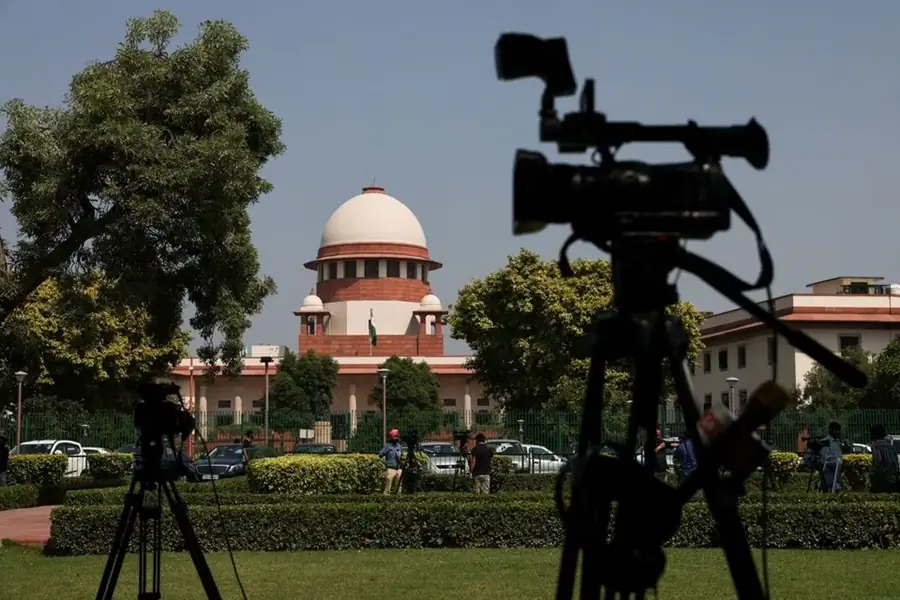
NEW DELHI, March 20 (Reuters) – Transparency activists and journalists are taking the government of Prime Minister Narendra Modi to India’s top court over its new privacy law, arguing the legislation will have a “chilling” effect on journalism and enable officials to withhold information of public interest.
Four lawsuits are due to be heard in the Supreme Court on March 23, following criticism from media and activists that Modi’s government is diluting a 20-year-old Right to Information (RTI) law that is similar to the Freedom of Information Act in the U.S.
Modi’s government has also faced criticism of curbing dissent through a stringent content removal regime. The government has denied the allegations and says it only orders removal of unlawful content and the RTI law continues to follow a principle of “maximum disclosure and minimum exemptions.”
The latest controversy surrounds a one-line amendment to the RTI law that came into force in November with the new privacy law, called the Digital Personal Data Protection Act, and excludes any “personal information” from release. Previously, the law allowed officials to release such information in “public interest”.
‘DEATH KNELL FOR PARTICIPATORY DEMOCRACY’
The lawsuits argue the change to the law should be quashed, because it would allow the government to deny the release of critical information of public interest, and undermine constitutional principles.
Anjali Bhardwaj, one of India’s most prominent transparency activists who is among those challenging the law, told Reuters the new law could, as an example, allow the government to block the release of the names of contractors or officials involved in allegedly substandard projects.
The change is “a death knell for participatory democracy, and ruinous to ideas of open governance,” RTI activist Venkatesh Nayak said in his court filing, reviewed by Reuters.
India’s law ministry and the Department of Personnel and Training, which has responsibility for the RTI law, did not respond to Reuters queries on the challenges.
IT minister Ashwini Vaishnaw told parliament last year the changes would “not restrict the disclosure of personal information” and “balances individuals’ privacy rights with the right to information.”
India’s ranking in the Canada-based Centre for Law and Democracy’s tracker has fallen from two in 2013 to nine currently, with researchers citing “blanket exceptions” in the RTI law for security agencies as one of the reasons.
WORRY AMONG SOME JOURNALISTS
India’s privacy law also introduced fines of up to $27 million for social media, technology firms and others that did not comply with the regulations, without providing an exemption for journalists.
Media groups say without that exemption reporters will need to satisfy a provision requiring consent which, in the case of reporting, means seeking permission from each individual or a company that is the subject of an article.
The Editors Guild of India has said the law could have an effect of “chilling newsgathering and hindering accountability journalism.”
In Reporters Without Borders World Press Freedom Index, India ranked 151 out of 180 countries last year, with the group citing “violence against journalists, highly concentrated media ownership, and political alignment” among its concerns. The country was ranked 106 out of 167 countries two decades ago.
New Delhi-based journalists’ group, The Reporters’ Collective, is among those challenging the law in the Supreme Court, saying in its court filing it would hamper effective reporting.
Britain and Australia exempt journalists from similar laws. The group told the court in its filing the Indian law would “force citizens and journalists to self-censor to avoid massive penalties.”
The proceedings in such cases can typically last several months before there is a final ruling.