
New Delhi, Dec 2, 2025: The Finance Ministry has finally cleared the fog around the merger of dearness allowance with basic salary under the 8th Pay Commission. In a written reply in Lok Sabha, the government clarified that there is no proposal regarding the merger of existing DA with basic salary that will be decided for the 8th CPC. The current DA is 58%, and there was a growing demand to merge it with the basic salary.
The Ministry of Finance was inquired about whether the government has issued notification for the constitution of 8th Central Pay Commission recently.
Also, the ministry was asked whether the government proposes to merge the existing DA/DR with basic pay as an immediate relief measure for Central Government employees/pensioners who are facing unprecedented inflation during the last 30 years since the DA/DR given to these employees is not in consonance with the real-time retail inflation.
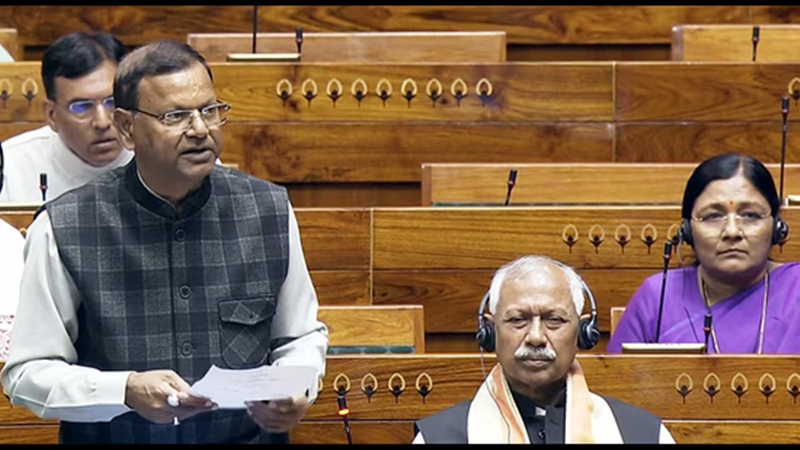
The Minister of State in the Ministry Of Finance, Pankaj Chaudhary, replied to the queries in Lok Sabha. In his written reply, Chaudhary said, “No proposal regarding merger of the existing Dearness Allowance with the Basic Pay is under consideration with the Government at present.
ln order to adjust the cost of living and to protect Basic Pay Pension from erosion in real value on account of inflation, the rates of DA,/DR are revised periodically every 6 months on the basis of All lndia Consumer Price lndex for lndustrial Workers (AlCPl-lW) released by Labour Bureau, Ministry of Labour and Employment.”
Dearness allowance is like an incentive paid by the government to its employees and pensioners as a move to enhance the cost of living of these personnel and retirees against inflation. DA is calculated as a percentage of the basic salary, and hence, it would vary from employee to employee. All central government employees and pensioners receive DA on their basic salary.
Many trade unions and employee representatives had demanded that the government merge 50% of the DA with basic pay.
However, the implementation of the 8th Pay Commission is expected to be delayed to 2027, and hence, these representatives demanded that an early merger of DA with basic pay could increase the salaries for employees and the future calculation of DA could be based upon the revised Pay scale.
Table of Contents
8th Pay Commission Implementation Date:
The Cabinet recently announced a temporary body, Terms of Reference (ToR), for the 8th CPC. The ToR is tasked with recommendations for the 8th Pay Commission. They are given an 18-month timeframe to submit the recommendations. ToR may consider, if necessary, sending interim reports on any of the matters as and when the recommendations are finalized.
Hence, 8th Pay Commission is not expected to be implemented on January 1, 2026. The 7th Pay Commission is ending on December 31, 2025. For the past four decades, the timeline to constitute every new pay commission was once in 10 years, and the recommendations get effective after the same cycle. The new pay commission has been effective from January 1st during the 4th to 7th Pay Commission.
8th Pay Commission Fitment Factor:
The fitment factor decides how much salaries will rise across different pay matrix levels. It is expected to range between 1.83 and 2.46. A higher factor means better take-home pay for employees and larger pensions for retirees. By aligning pay with current inflation and living costs, the 8th Central Pay Commission could become one of the most generous in recent times.
FAQs
Will the Government Merge Dearness Allowance with Basic Salary?
The Government of India has confirmed there is no proposal to merge the existing 58% Dearness Allowance with the Basic Pay. Minister of State for Finance Pankaj Chaudhary stated in Lok Sabha that periodic revisions every six months remain the primary mechanism for adjusting inflation.
When will the 8th Pay Commission be implemented?
The 8th Pay Commission implementation is expected to occur in 2027, following the submission of recommendations by the Terms of Reference (ToR) body. Although the 7th Pay Commission cycle ends on December 31, 2025, the current 18-month review timeline precludes a January 2026 launch.
How does the 8th CPC Fitment Factor affect employee salaries?
The fitment factor for the 8th Pay Commission is projected to range between 1.83 and 2.46, serving as the multiplier for revised pay scales. This metric determines the total salary increase across various levels of the pay matrix for central government personnel and retirees.
What is the current Dearness Allowance (DA) rate for 2025-2026?
The current Dearness Allowance (DA) is set at 58% of the Basic Pay, effective from July 1, 2025. This follows a recent 3% increment approved by the Union Cabinet to compensate Central Government employees and pensioners for the rising cost of living and inflation.
Will the Government merge Dearness Allowance with Basic Salary?
The Government of India has officially confirmed there is no proposal to merge the existing 58% Dearness Allowance (DA) with the Basic Pay. Minister of State for Finance Pankaj Chaudhary stated in Lok Sabha that periodic revisions remain the established mechanism for inflation adjustment.
When is the 8th Pay Commission implementation date?
The 8th Pay Commission is expected to be implemented in 2027, following the submission of recommendations by the Terms of Reference (ToR) body. While the 7th CPC cycle concludes on December 31, 2025, the current 18-month panel timeline prevents a January 2026 start.
What is the expected 8th CPC Fitment Factor?
The fitment factor for the 8th Pay Commission is projected to range between 1.83 and 2.46. This multiplier is applied to the existing Basic Pay to determine the new salary structure across various levels of the official pay matrix.