

Gold Coast, Sep 3 (The Conversation) In mid-August, controversy enveloped the Bendigo Writers Festival. Just days before it began, festival organisers sent a code of conduct to its speakers – a code that drove more than 50 authors to make the difficult decision to pull out.
The code was intended to ensure the event’s safety, with a requirement to “avoid language or topics that could be considered inflammatory, divisive, or disrespectful”. Yet distressed speakers argued it made them feel culturally unsafe. Speakers on panels presented by La Trobe university were also required to employ a contested definition of antisemitism.
The incident is the most recent in a series of controversies in which progressive writers and artists have faced restrictions and cancellations, with organisations citing “safety” as the reason. They include libraries cancelling invited speakers and asking writers to avoid discussing Gaza, Palestine and Israel.
How did speech rules developed and promoted by the progressive left – rules promoting cultural safety and safe spaces – become tools that could be wielded against it?
Applying ‘safety’ to speech
Over recent years, “safety” – including in terms like “safe spaces” and “cultural safety” – has become a commonly raised ethical concern. Safe-speech norms often arise in the context of public deliberation, education and political speech.
“Safe spaces” are places where marginalised groups are protected against harassment, oppression and discrimination, including through speech like microaggressions, unthinking stereotypes and misgendering. Within safe spaces, protected groups are encouraged and empowered to speak about their experiences and needs.
Similarly, “cultural safety” refers to environments where there is no challenge or denial of people’s identities, allowing them to be genuinely heard. This can be crucial for First Nations communities, especially in health and legal contexts.
Safe-speech norms are therefore complex. They involve the freedom to speak, but also freedom from speech.
This way of thinking takes a broad view of the kinds of speech that can be interpreted as harmful or violent. Harmful speech does not just include hate speech and incitement. It also includes speech with unintended consequences and speech that challenges a person’s perceived identity.
These safe-speech norms, increasingly adopted in universities and other broadly progressive organisations, should be distinguished from “psychological safety”. This earlier concept refers to creating environments – such as workplaces – where it is safe to speak up, including to raise concerns or ask questions.
While psychological safety is a general norm protecting all parties, the more recent safe-speech norms protect specific marginalised groups. They aim to push back against larger systemic forces like racism or misogyny that would otherwise render those groups oppressed or unsafe. In some cases, the prioritisation of safety has led to deplatforming of speakers at universities.
With this special focus on oppressed minorities and heightened sensitivity to speech’s negative impacts, applying these norms has become a familiar part of progressive social justice efforts (sometimes pejoratively called “wokism”). Now, conservatives and others are employing the language of cultural safety to close down discussion of topics such as the war in Gaza.
Are safe-speech norms controversial?
By constraining what can be said, safe speech norms impinge on other potentially relevant ethical norms, such as those of public deliberation. These “town square” norms aim to encourage a diversity of views and allow space for a robust dialogue between different perspectives.
Public deliberation norms might be defended as part of the human right to free speech, or because arguing and deliberating with other people can be an important way of respecting them.
Alternatively, public deliberation can be defended by appeal to democracy, which requires more than merely casting votes. Citizens must be able to hear and voice different perspectives and arguments.
Those in favour of free speech and the public square will look suspiciously at safe-speech norms, worrying that they give rise to the well known risks of political censorship. Thinkers like Jonathan Haidt and Greg Lukianoff explicitly criticise “safetyism”, arguing the prioritisation of emotional safety inappropriately coddles young people.
Supporters of safe-speech norms might respond in different ways to these objections. One response might be that safety doesn’t intrude very much on dialogue anyway (at least, not on the type of dialogue worth having). Another response might be to challenge the value of public debate itself, seeing any system that does not explicitly work to support the marginalised as inherently oppressive.
Yet another response might be to query whether writers festivals are an apt place for public debate. Most speakers want an enjoyable experience and to promote their book (even when such books explore contentious ideas). Many in the audience will be supportive of the authors’ ideas and positions. Some will even be fans. Maybe it’s not so bad if most festival sessions are “love-ins”.
Prohibited vs. protected
In order to protect and empower specific marginalised groups, safe-speech norms both support and restrain speech. So long as the views of these protected groups are relatively aligned with each other, these norms work coherently. The speech that is being prohibited doesn’t overlap with the speech that is being protected.
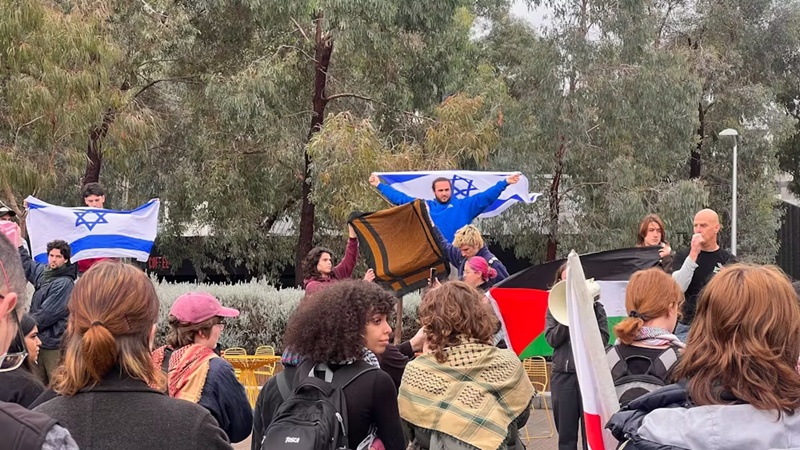
But what happens when members of two marginalised groups have stridently opposed views and the words they use to decry injustice are called unsafe by their opponents? Once this happens, the speech that one group needs to be protected is the same speech that the other group needs prohibited.
Perhaps it was inevitable that the internal contradictions of safe-speech norms would eventually create such problems. In Australia, like many countries, this was triggered by the October 7 Hamas atrocity and Israel’s unrelenting and brutal military response. Jews and Palestinians are both vulnerable minorities who face the well known bigotries of antisemitism and Islamophobia respectively. They both can reasonably demand the protection of safe-speech norms.
However, is each side interested in respecting the other’s right to such norms? Author and academic Randa Abdel-Fattah has reportedly alleged on social media, that if you are a Zionist, “you have no claim or right to cultural safety”. In turn, she says she has been harrassed and threatened over her views on the war in Gaza, and public institutions hosting her “have been targeted with letters defaming me and demanding I be disinvited”.
Perhaps the time has come to acknowledge that safe speech norms were never as straightforward or innocuous as they first appeared. They require a form of censorship that not only involves choosing political sides, but inevitably making fine-grained judgements between which opposing minority deserves protection at the expense of the other.
Indeed, safe speech norms may themselves be exclusionary. The US organisation “Third Way” advocates for moderation and centre left policies. In a recent memo it said research among focus groups had consistently found ordinary people interpreted key terms from progressive political language as alienating and arrogant.
According to Third Way, the term “safe space” (among others) communicates the sense that, “I’m more empathetic than you, and you are callous to hurting others’ feelings.”
With all this in mind, I find it hard to disagree with author Waleed Aly’s recent reflection that “in arenas dedicated to public debate, safety makes a poor organising principle”. Efforts to support and include marginalised voices are laudable. However, safe-speech norms are a deeply problematic – and perhaps ultimately contradictory – tool to use in pursuing that worthy goal.