
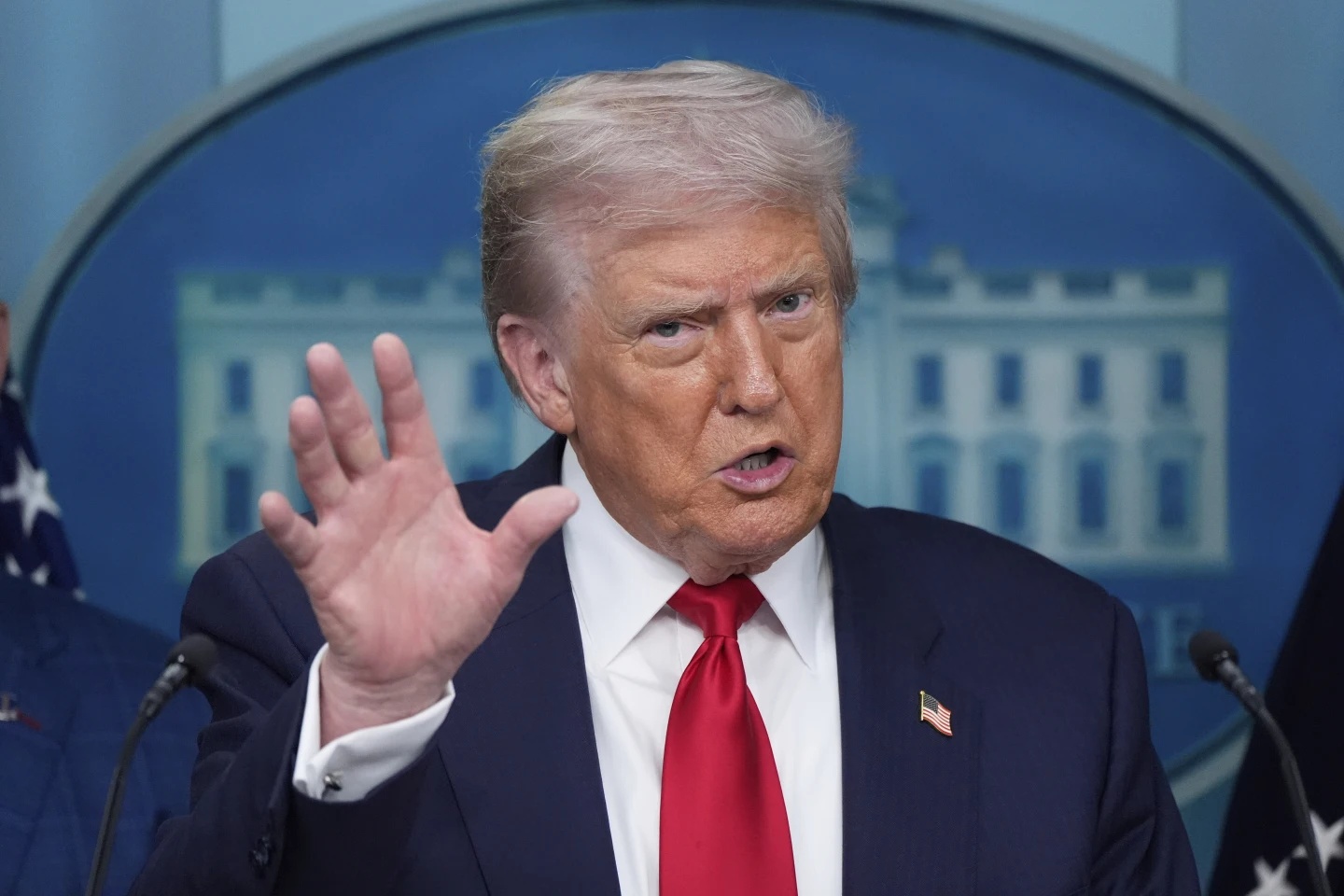
WASHINGTON (AP): As the Iran war intensifies, President Donald Trump has prioritized efforts to calm the financial markets — trying to keep oil prices from exploding upward, stocks from cratering and interest rates from surging.
When the markets have flashed danger, Trump has been quick with a social media post or a remark to claim the war he launched last month could soon end. He’s publicly declared that the markets are doing better than he expected, even with the S&P 500 stock index declining over the past five weeks and the global oil benchmark up roughly 60%.
“I thought oil prices were going to go up higher than they are now,” Trump said at a Friday investor summit. “And I thought that we would see a bigger drop in stock. It hasn’t been that bad.”
With the Iran war, the White House has largely refrained from messaging more aggressively to voters about the economic consequences — choosing instead to try to contain any damage in the financial markets, which have swung wildly on the prospects of ceasefire or escalation in what has become a high-stakes guessing game about Trump’s next moves.
The Republican president showed the extremes of his messaging Monday before the U.S. stock market opened, writing in a social media post that great progress had been achieved on peace talks with Iran while also threatening civilian infrastructure such as desalination plants if a deal wasn’t reached “shortly.”
The White House sees the stock, energy and bond markets as a way to indirectly reach voters. Trump has staked his economic agenda on cheap prices at the pump, robust gains in 401(k) accounts and cheaper mortgage rates.
But that messaging appears to be wearing thin as the president’s various pronouncements have done little to change the reality that a large chunk of the world’s energy supplies is stranded by the conflict. Just 38% of U.S. adults approve of how he’s handling the economy and only 35% support him on Iran, according to a March survey by The Associated Press-NORC Center for Public Affairs Research.
Table of Contents
The president has tried to dictate to markets instead of talking directly to Americans
Gene Sperling, a top economic adviser in the Democratic Clinton, Obama and Biden administrations, said voters can make a direct connection between prices at the pump and Trump’s choice to attack Iran. He said “simplistic jawboning” to the markets is insufficient for a public that is stuck paying the price as gasoline soars past $4 a gallon nationwide.
“Most advisers would say the president has to speak directly to the American people and fully acknowledge the economic pain that his policy has so directly caused in a short amount of time and make the case for why the national security concerns justify it,” Sperling said. “Instead, you have a strategy of not recognizing or even dismissing people’s economic pain.”

White House press secretary Karoline Leavitt on Monday called the oil price increases a “short-term fluctuation.”
Trump’s strategy of giving mixed messages has started to work against him, said Jeffrey Sonnenfeld, a professor at the Yale University School of Management and co-author of the new book “Trump’s Ten Commandments: Strategic Lessons from the Trump Leadership Toolbox.”
“The uncertainty is now soaring,” Sonnenfeld said. “As the messaging to calm markets with false reassurances is having diminishing credibility in financial markets, so, too, has Trump diminished public confidence.”
Trump’s desire for flexibility on the war limits his ability to offer clarity
Trump has embraced having flexibility in how he chooses to conduct the war, even though this has muddled his stated objectives.
During a Cabinet meeting Thursday, he said Iran was “begging” for a deal even as he threatened further military action — all the while maintaining that any economic damage to the U.S. would reverse itself.
On Friday after the markets closed, he extended his deadline for Iran to open the Strait of Hormuz, a key waterway for the flow of oil, saying he would hold off on bombing Iran’s energy plants in the meantime.
Treasury Secretary Scott Bessent said Monday on Fox News Channel’s “Fox & Friends” that Iran was letting some tankers through the Strait of Hormuz and that the “market is well supplied” because countries are releasing their strategic petroleum reserves and sanctions have been removed for Russian and Iranian oil already on tankers.
“We are seeing more and more ships go through on a daily basis as individual countries cut deals with the Iranian regime for the time being,” Bessent said. “But over time, the U.S. is going to retake control of the straits, and there will be freedom of navigation, whether it is through U.S. escorts or a multinational escort.”
Graham Steele, a Biden-era Treasury official, said Trump’s messaging techniques “can work temporarily, but they have diminishing returns, over time,” if they’re detached from actual policies and results.
“We saw a lot of the volatile market reactions initially, when he kept announcing these things and then walking them back,” Steele said. “The market reaction now is just a steady trend upward in prices,” he noted, adding that markets are “not responding to it in the same way anymore.”
Confidence in the economy and Trump is fading without clear results
The University of Michigan’s Index of Consumer Sentiment on Friday fell to a reading of 53.3 in March, its lowest level since December. Joanne Hsu, director of the surveys of consumers, pointed to the financial market volatility “in the wake of the Iran conflict” as reducing confidence in the economy for households with middle and higher incomes.
Hsu noted that the survey indicated that people do not expect the higher energy costs and stock market declines to persist, but that could change if the war “becomes protracted or if higher energy prices pass through to overall inflation.”
Gus Faucher, the chief economist at PNC Financial Services, stressed that low levels of consumer sentiment do not automatically signal a recession. But he said consumers would have to see lower gas prices, a steady stock market and decreased mortgage rates to feel better about the economy, which likely means a definitive resolution to the conflict rather than a series of pronouncements by Trump.
“The proof is in the pudding,” Faucher said. “People need to see some substantive improvements before they feel better about conditions.”
Everything You Need to Know
How is the war with Iran currently affecting U.S. gas prices and inflation?
Gas prices have surged past $4 a gallon nationwide as the conflict strands a significant portion of the global energy supply. While the White House characterizes these spikes as “short-term fluctuations,” the 60% increase in global oil benchmarks threatens to drive broader inflation if the war becomes protracted.
What is President Trump’s strategy for stabilizing the financial markets?
President Trump is utilizing “jawboning,” or strategic social media posts and public remarks, to project optimism and hint at imminent peace deals. This approach aims to prevent stocks from cratering and interest rates from surging by managing investor expectations through direct, often contradictory, messaging.
Why is consumer confidence falling despite the President’s optimistic remarks?
Consumer sentiment has dropped to its lowest level since December because the public remains wary of market volatility and high energy costs. Economists note that “simplistic jawboning” is losing effectiveness as voters prioritize substantive improvements—like lower prices at the pump—over rhetorical reassurances.
How is the conflict in the Strait of Hormuz impacting global oil supplies?
The Strait of Hormuz, a critical maritime chokepoint, has seen restricted flow, though some tankers are now passing through via individual deals with the Iranian regime. To mitigate the impact, the U.S. and other nations are releasing strategic petroleum reserves and utilizing escorted navigation to maintain global supply levels.
What are the main economic risks if the Iran war continues?
The primary risks include a sustained decline in the S&P 500, higher mortgage rates, and a potential recession triggered by low consumer confidence. If higher energy prices pass through to overall inflation, the Federal Reserve may face increased pressure to manage interest rates amid the ongoing geopolitical instability.
This report is based on the Associated Press article written by Josh Boak and Fatima Hussein. The Sen Times holds no responsibility for its content.