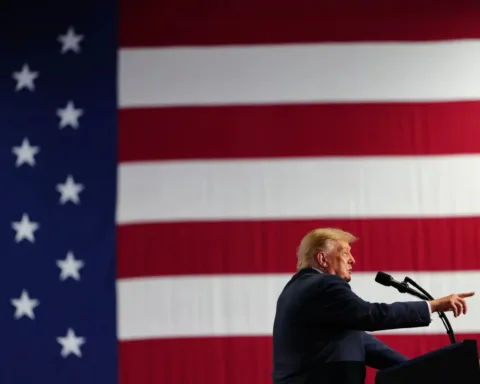

WASHINGTON/DUBAI/TEL AVIV, April 9 (Reuters) – U.S. President Donald Trump vowed to retain military assets in the Middle East until a peace deal with Iran is reached and warned of a major escalation in fighting if it failed to comply, as oil prices rose on concerns over supply and restrictions in the Strait of Hormuz.
Trump said in a social media post U.S. ships, aircraft and personnel with additional ammunition and weaponry would remain in place to destroy, if necessary, “a substantially degraded enemy”, but expressed confidence that a lasting deal would be agreed and followed.
“If for any reason it is not, which is highly unlikely, then the ‘Shootin’ Starts,’ bigger, and better, and stronger than anyone has ever seen before,” Trump said, adding that contrary to “fake rhetoric”, Iran had agreed not to pursue nuclear weapons and to reopen the Strait of Hormuz.
“In the meantime our great Military is Loading Up and Resting, looking forward, actually, to its next Conquest. AMERICA IS BACK!”
Though both the United States and Iran declared victory in a five-week-old war that has killed thousands, their core disputes remained unresolved, with each side sticking to competing demands for a deal that could shape the Middle East for generations.
IRAN SAYS TALKS ‘UNREASONABLE’ AMID ISRAELI STRIKES
Trump’s latest post followed the largest coordinated strike of the war by Israel on Wednesday that killed more than 250 people in Lebanon, prompting a warning from Iran’s lead negotiator that Israel’s ramping up its parallel war and Washington’s insistence on Tehran abandoning its nuclear ambitions could jeopardise talks to forge a permanent peace deal.
“In such a situation, a bilateral ceasefire or negotiations were unreasonable,” Iran’s parliament speaker Mohammed Bager Qalibaf, said in a statement on Wednesday.
Oil prices climbed on Thursday with investors concerned about the fragility of the truce and elevated geopolitical risks over Middle East supply, with doubts that restrictions in the Strait of Hormuz would soon ease.
Brent crude futures were up $1.96, or 2.07%, at $96.71 a barrel at 0325 GMT, while U.S. West Texas Intermediate crude rose $2.6, or 2.75%, to $97.01 a barrel, a day after both benchmarks had fallen sharply on the ceasefire announcement.
Brent crude and West Texas Intermediate remain far above the $70.75 and $65 a barrel before the joint U.S.-Israel onslaught began.
Asian share markets were in a sober mood on Thursday amid unease about the ceasefire, with Japan’s Nikkei lingering either side of flat having jumped 5.4% the previous session and the MSCI’s broadest index of Asia-Pacific shares outside Japan easing 0.7%.
On Wall Street, S&P 500 futures and Nasdaq futures were both off 0.2% as Wednesday’s surge ended and in Europe, the EUROSTOXX 50 futures eased 0.1%, DAX futures fell 0.5% while FTSE futures were up 0.4%.
CONTRASTING AGENDAS
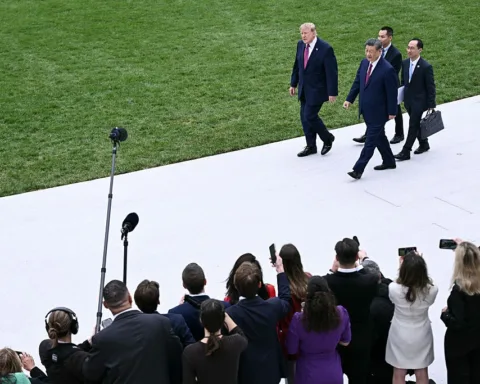
Israel’s blitz of air strikes on Wednesday raised questions about regional truce efforts, with conflicting messages on the scope of the ceasefire and sharply contrasting agendas for peace talks set to start on Saturday in Pakistan.
The United States and Israel say Lebanon is not included in the agreement, while Iranian President Masoud Pezeshkian has said a halt in hostilities in Lebanon was an essential condition of Tehran’s deal with Washington.
The Iran-backed Hezbollah said it fired rockets early on Thursday at the small kibbutz of Manara, citing what it described as Israel’s ceasefire violations, warning of more until there was a halt in “Israeli-American aggression”.
Pakistan’s foreign ministry condemned the Israeli operations on Thursday, which it said “undermine international efforts to establish peace and stability”.
French President Emmanuel Macron earlier said Lebanon “must be fully covered” by the ceasefire.
Iran’s delegation for the talks was due to arrive in Islamabad on Thursday night.
“Despite scepticism of Iranian public opinion due to repeated ceasefire violations by Israeli regime … Iranian delegation arrives tonight in Islamabad for serious talks based on 10 points proposed by Iran,” Ambassador Reza Amiri Moghadam said in a post on X on Thursday.
‘FREEDOM OF NAVIGATION MEANS NAVIGATION MUST BE FREE’
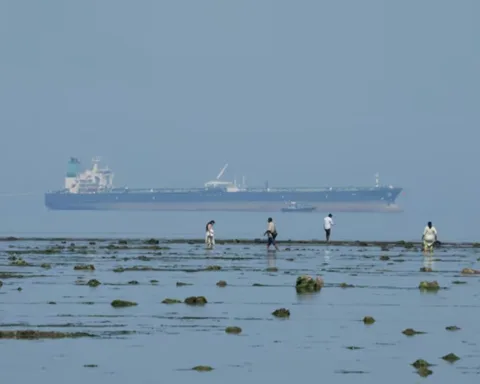
There was scant sign that the Strait of Hormuz was open in any meaningful way since the truce agreement, with Iran still asserting its control over the vital artery, a conduit for a fifth of the world’s oil and liquefied natural gas supply, and demanding tolls for safe passage.
Tehran’s newly demonstrated ability to cut off Gulf energy supplies through its grip on the strait, despite decades of massive U.S. military investment in the region, shows how the conflict has already altered power dynamics in the Gulf.

Iran’s Revolutionary Guards navy posted a map on Thursday showing alternative shipping routes in the Strait of Hormuz to help ships avoid naval mines, the semi-official Iranian news agency ISNA said.
British Foreign Secretary Yvette Cooper will say on Thursday that shipping through the Strait of Hormuz, must be toll-free, countering a push by Iran to control a channel long treated as an international waterway.
“The fundamental freedoms of the seas must not be unilaterally withdrawn or sold off to individual bidders. Nor can there be any place for tolls on an international waterway,” Cooper will say in an annual foreign policy speech in London, according to advance extracts.
“Freedom of navigation means navigation must be free.”
This report is given by Reuters. The Sen Times holds no responsibility for its content.
Is Trump planning a major war escalation in Iran?
President Donald Trump has issued an ultimatum for total military escalation if the current two-week ceasefire fails to yield a permanent settlement. While expressing confidence in a deal, Trump confirmed that U.S. forces are “loading up” and prepared for the “biggest” military offensive in history.
What are the terms of the Iran 10-point peace plan?
The 10-point peace plan includes demands for a permanent cessation of hostilities, the lifting of all U.S. sanctions, and the release of frozen Iranian assets. Crucially, the plan mandates the recognition of Iran’s right to uranium enrichment and the establishment of a protocol for the Strait of Hormuz.
Will the Strait of Hormuz reopen for oil tankers?
The Strait of Hormuz has partially reopened under a temporary “permission-based” model for the duration of the two-week ceasefire. However, full restoration of Freedom of Navigation remains stalled as Iran asserts de facto control, requiring vessels to obtain naval clearance before transiting the waterway.
How do Iranian shipping tolls affect global energy prices?
Market data shows that Brent crude futures rose above $96 per barrel due to Iran’s proposed $1 per barrel transit fee on oil tankers. This “Tehran toll booth” significantly increases the marginal cost of energy, as the Strait of Hormuz handles roughly 20% of global liquefied natural gas (LNG) and petroleum.
What is the impact of Israeli strikes on the Lebanon ceasefire?
Recent Israeli airstrikes in Lebanon, which resulted in over 250 casualties, have placed the “fragile truce” in immediate jeopardy. Iran has classified these strikes as “unreasonable” violations, asserting that a halt in hostilities across the Blue Line is a mandatory prerequisite for any permanent peace deal.