

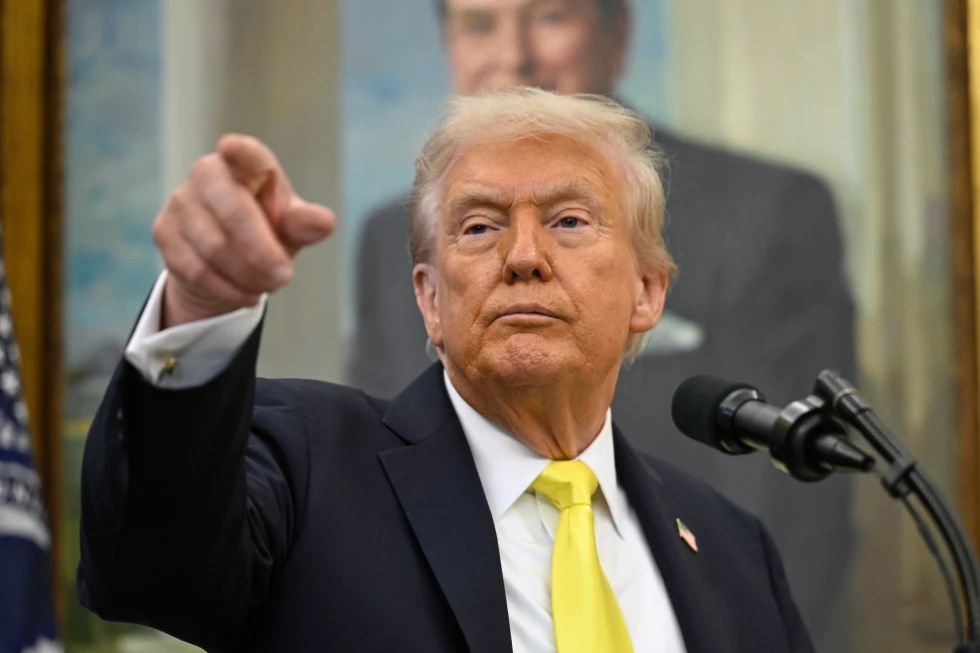
President Donald Trump said Thursday he will soon sign an order to pay all Department of Homeland Security employees who have gone without paychecks during the partial government shutdown that has reached 48 days.
He announced the unilateral move in a social media post, blaming Democrats for the impasse while thanking Republican leaders for their work this week in trying to end the standoff.
The Republican president used a similar maneuver to resume pay for the Transportation Security Administration after many employees had called out from work, resulting in long delays at airport security lines for travelers. Trump’s latest intervention is expected to apply to other non-law enforcement employees at the department, including the Federal Emergency Management Agency and the U.S. Coast Guard and support staff.
Trump said their families “have suffered far too long.”
“Nevertheless, help is on the way for our Brave and Patriotic Public Servants who have continued to work hard, and do their part to protect and defend our Country,” Trump said.
The DHS funding lapse had seemed likely to stretch into next week as the House is contemplating passing a Senate plan it had previously rejected to fund the bulk of the agency, but not its immigration enforcement operations.
There was no legislative resolution Thursday after both chambers met for just a few minutes in pro forma sessions. Nonetheless, the Republican leadership and Trump had coalesced around a plan to fully fund DHS as part of a two-step process. The agreement puts the congressional leaders on the same page for ending the impasse after they had pursued separate paths that resulted in Congress leaving Washington last week for its spring recess without a fix.
During the brief sessions, Senate Majority Leader John Thune, R-S.D., put aside the House plan to fund the entire department for 60 days. Then the House met briefly without taking up the bipartisan Senate plan that had been worked out with Democrats, though Thune is looking toward eventual passage.
“I don’t know the particulars around what the House will do with it,” Thune told reporters. “My assumption is, at some point, hopefully, they’ll move it.”
Table of Contents
Johnson’s about-face
Speaker Mike Johnson, R-La., and Thune, announced Wednesday that they would return to the Senate measure, which funds most of DHS with the exception of U.S. Immigration and Customs Enforcement and U.S. Border Patrol. Republicans will try later to fund those agencies through party-line spending legislation that could take months to finish.
Neither outcome is guaranteed, and the strategy could potentially still face opposition from the GOP’s own ranks even though Trump has given his support.
Johnson’s embrace of the two-track plan marks a sharp reversal from less than a week ago, when he derided it as a “joke” and said he was “quite convinced that it can’t be that every Senate Republican read the language of this bill.”
He now appears to be on board. But securing support from his own conference could prove more difficult after a sizable group of House Republicans blasted the Senate-passed bill last week.
House Republicans were expected to hold a conference call later Thursday to discuss the next steps.
Thune pointed to a “number of conversations” when he was asked how the Republican leadership and Trump aligned to move ahead after their apparent divisions a week earlier.
“The thing that some people want to do, we can’t do,” said Thune. “And so you have to figure out what’s in the realm of the possible. And you have to just continue to define reality for people.”
Funding ICE and Border Patrol remains a hurdle
Democrats in both chambers were aligned last week with the Senate funding plan passed with bipartisan support. Senate Democratic leader Chuck Schumer of New York on Wednesday blamed Republicans for not acting more quickly.
“Republican divisions derailed a bipartisan agreement, making American families pay the price for their dysfunction,” Schumer said.
Even with the progress, the most conservative lawmakers are likely to seek full funding for all of Trump’s immigration and deportation operations.
“Let’s make this simple: caving to Democrats and not paying CBP and ICE is agreeing to defund Law Enforcement and leaving our borders wide open again,” Rep. Scott Perry, R-Pa., posted on X. “If that’s the vote, I’m a NO.”
Meanwhile, the budget package that Trump wants prepared for later this year is expected to fund ICE and Border Patrol through the remainder of Trump’s term, as a way to try to ensure those agencies are no longer at risk from Democrats objecting to his immigration enforcement agenda. Trump said he wants that legislation on his desk by June 1.
Thune acknowledged the potential hurdles to that route, such as efforts to expand the scope of the bill. He said the goal is to keep it “as narrow and focused as possible” to speed passage.
“We need to kind of move with haste,” he said. “It’s probably not a likely magnet for all these other issues.”
This report is given by Associated Press. The Sen Times holds no responsibility for its content.
FAQs
How will the new executive order affect DHS employee pay during the shutdown?
President Donald Trump will sign an executive order to resume pay for Department of Homeland Security employees following a 48-day funding lapse. This unilateral action targets non-law enforcement personnel, including FEMA and Coast Guard staff, to mitigate financial hardship caused by the ongoing legislative impasse between Congressional chambers.
What is the two-step process for funding the Department of Homeland Security?
Republican leadership has coalesced around a two-track strategy to resolve the DHS funding crisis. The plan involves passing a bipartisan Senate measure to fund the majority of the department immediately, followed by separate party-line spending legislation to address contentious immigration enforcement and border security operations later this year.
Why are ICE and Border Patrol excluded from the initial funding plan?
U.S. Immigration and Customs Enforcement (ICE) and U.S. Border Patrol remain unfunded due to deep partisan divisions regarding immigration enforcement and deportation operations. While Democrats support the general Senate funding plan, conservative Republicans argue that excluding these agencies is equivalent to defunding law enforcement and compromising border integrity.
What impact does the shutdown have on FEMA and the U.S. Coast Guard?
The 48-day partial government shutdown has halted regular paychecks for non-law enforcement personnel within the Federal Emergency Management Agency (FEMA) and the U.S. Coast Guard. President Trump’s anticipated executive order is specifically designed to provide financial relief to these support segments while legislative battles over border security continue.
Why has Speaker Mike Johnson reversed his stance on the Senate funding plan?
Speaker Mike Johnson transitioned from labeling the Senate plan a “joke” to embracing it as a pragmatic solution to end the 48-day impasse. This “about-face” resulted from coordinated negotiations with Senate Majority Leader John Thune and President Trump to establish a path forward that “defines reality” for the House Republican conference.
How does the June 1st deadline affect future immigration enforcement funding?
President Trump has set a June 1st deadline for a specific budget package designed to fund ICE and Border Patrol through the end of his term. This strategy aims to insulate immigration enforcement operations from future “Democrats objecting to his agenda” by securing long-term appropriations in a narrow, focused legislative vehicle.