
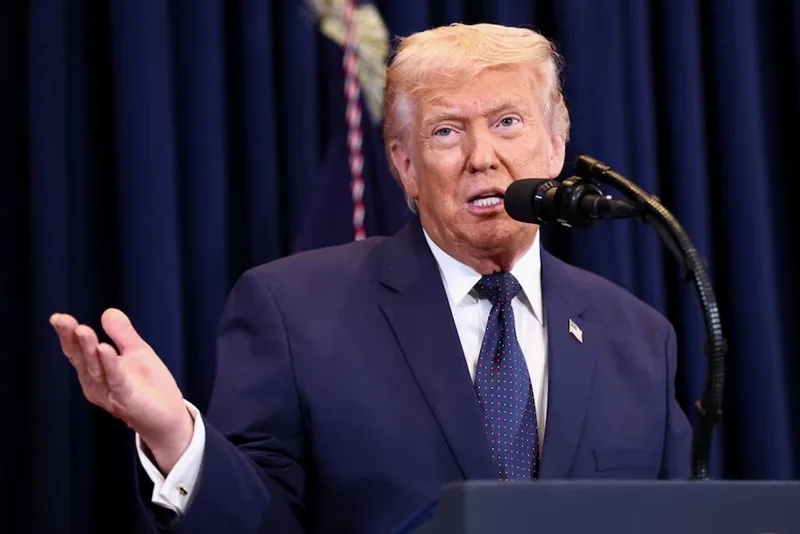
HOUSTON, March 11 (Reuters) – President Donald Trump on Tuesday announced the construction of a refinery on the southern U.S. border backed by India’s Reliance Industries, operator of the world’s biggest refining complex.
Trump made the announcement as drivers react to spiking gasoline prices since the start of the U.S.-Israeli war with Iran, and while Republicans and Democrats prepare for midterm elections that could determine which party controls Congress through the last two years of his presidency.
“Thank you to our partners in India, and their largest privately held Energy Company, Reliance, for this tremendous Investment,” Trump said on social media platform Truth Social.
The 168,000 barrels-per-day (bpd) refinery will be built at the port of Brownsville and will offset $300 billion in the trade deficit with India, startup America First Refining said in a statement.
Reliance did not respond to an emailed request for comment.
“For the first time in half a century, the United States will build a new refinery designed specifically for American shale oil,” said America First’s chairman and founder, John V. Calce.
Many Gulf Coast refineries are unable to process light, sweet crude oil from fracking shale fields because they were configured in the last 40 years to run lower-cost heavy, sour crude, which has higher density and contains more sulfur.
A “global supermajor” has provided a “9-figure investment” at a “10-figure valuation,” America First said.
Trump named the investor as Reliance, India’s largest private-sector company.
Reliance has signed “a binding 20-year offtake term sheet” with America First, meaning it will buy products the refinery produces. That will help cut India’s trade surplus with the U.S., which has been a Trump grievance.
America First said it plans to break ground in the second quarter of this year.
INDUSTRY EXPERTS QUESTION NEED
Analysts were skeptical about the need for a new refinery on the Gulf Coast, which is already home to eight of the country’s 10 largest refineries.
“Initial announcements like this by the Trump administration have a lot of hyperbole,” said Refined Fuels Analytics managing director John Auers.
The new refinery will “fuel U.S. markets, strengthen our national security, boost American energy production, deliver billions of dollars in economic impact, and will be the cleanest refinery in the world,” Trump said on Truth Social.
Gulf Coast refineries have advantages over plants elsewhere in the U.S., said Kloza Advisors principal analyst Tom Kloza.
“If Brownsville is indeed the location for the build, I would assume that they are looking at an export refinery,” Kloza said. “There is not much local demand and there are not pipeline connections to take Brownsville product elsewhere.”
U.S. refineries are the major suppliers of motor fuel and heating oil to South America, Kloza said, and have lower costs for natural gas, hydrogen and domestic crude oil.
“Let’s see what develops,” he said. “Reliance is a very successful company.”
Reliance operates the 1.4 million bpd refining complex in Jamnagar, India, the world’s largest. The firm, which reported $125 billion in revenue last year, also operates businesses in retail, new energy, digital services, media and entertainment.
Since late 2025, two California refineries with combined capacity of 284,000 bpd have permanently closed, citing the state’s regulation of fossil fuel industries.
The cost of construction of refineries or additions to refineries in the past decade has averaged about $40,000 per barrel of capacity, or about $6.7 billion for 168,000 barrels.
U.S. refining capacity was 18.4 million bpd at the end of 2024, showed data from the U.S. Energy Information Administration. That is set to grow through gradual increase in capacity into the 2030s, Auers said.