

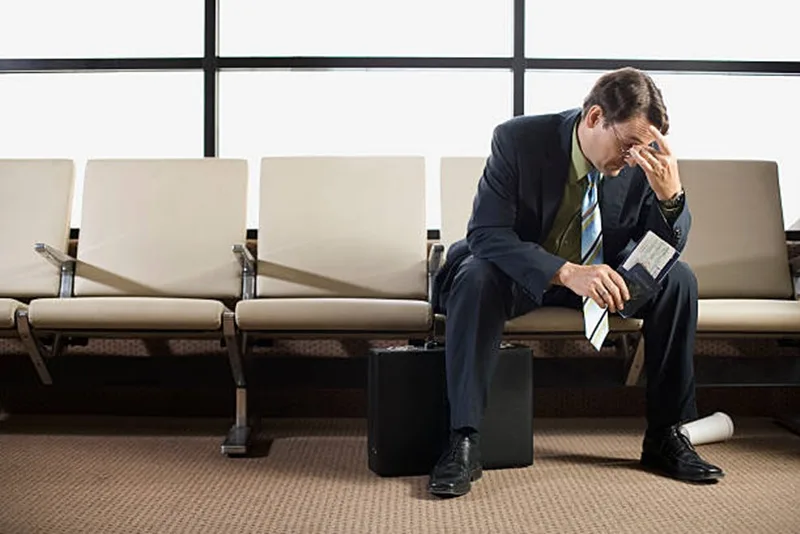
It’s 7:42 and the train departs at 8:10. The screen announces a platform change, but the announcement is barely understandable. A person drags two suitcases, looks for their ticket on their phone, and checks for the third time that they’re at the correct station. At an airport, another traveler checks the boarding gate, their watch, and the security line.
The journey hasn’t even begun, and the body is already behaving as if there’s a threat. We often associate this unease with a fear of flying, but pre-travel anxiety is much broader. It also appears in train stations and affects people who aren’t afraid of planes or trains. The problem isn’t always the transportation itself, but rather what we should do before boarding it.
Few everyday situations present so many demands at once: arriving on time, finding our way in an unfamiliar space, interpreting potentially changing messages, protecting our luggage, and making quick decisions amidst hundreds of stimuli. The margin for error seems minimal, and many of the important variables are beyond our control.
This combination of uncertainty, time pressure, and overload makes airports and stations particularly conducive to the emergence of anxiety.
Traveling means letting go of control
Anticipatory anxiety is triggered when we believe something negative might happen and we don’t know if we can prevent it. Large transit spaces meet all these conditions. We have to arrive at a specific time, follow instructions, locate an exit, and adapt to decisions made by others.
In psychology, intolerance of uncertainty describes the difficulty in accepting that we cannot know or control what will happen. During a trip, questions multiply: Will there be traffic? Will they change the platform? Will I miss my connection? Their accumulation keeps the brain on high alert.
A chain of small threats
For many people, stress doesn’t come from imagining a catastrophe, but from a string of possible mishaps. Going to the wrong terminal, not understanding a sign, or discovering that the train departs from a different level might seem trivial from home.
A study on anxiety related to air travel found that delays could cause more anxiety than some phases of the flight. Baggage and check-in procedures were also stressful.
Something similar happens on the railway. Research on delays and passenger information shows that waiting becomes especially unpleasant when the information is inaccurate. Not knowing how long a delay will last is often more difficult than knowing its duration.
The brain under pressure
At airports and train stations, we keep an eye on our luggage, interpret signs, listen to announcements, check the time, and decide which way to go next. This combination consumes a lot of attentional resources.
When we feel we have little time left, our attention narrows. We process information faster, but not necessarily better. Studies on decision-making under time pressure indicate that having less time alters visual exploration and the evaluation of options.
Hence the paradox: the more afraid we are of making a mistake, the harder it can be to find the right sign. We look a lot, understand less, and keep checking what we’ve already checked.
Noise, crowds, and disorientation
Public address systems, conversations, suitcase wheels, lights, shops, and people moving in different directions create a demanding sensory landscape. Evidence links transport noise to increased anxiety , although its effects depend on the intensity and individual sensitivity. Furthermore, a review of overcrowding and stress on rail transport indicated that a perceived lack of space and control can exacerbate discomfort.
Finding your way around isn’t a purely rational task either. Research on wayfinding in airport terminals highlights the importance of visibility, decision points, and floor changes. Passengers also describe experiencing more negative emotions in transfer areas, according to a study on movement within stations .
When space helps to regain calm
Changi Airport in Singapore has incorporated this idea into its design. In addition to gardens and rest areas, its Terminal 2 features a Calm Room with adjustable lighting and cushioned areas for travelers experiencing sensory overload.
Not all airports or train stations can install a waterfall or a tropical garden. Research on the physical environment of airports indicates that functional layout, lighting, and environmental quality influence anxiety.
Perhaps the most effective measures are less spectacular: understandable signs, up-to-date information, intuitive routes, visible staff, quiet spaces, and places to sit without consuming.
What can the traveler do
Responsibility shouldn’t fall solely on the individual, but some strategies can reduce anxiety. The first is to decrease uncertainty: review the route, identify the correct terminal or station, and familiarize yourself with the main steps. This isn’t about compulsively checking everything, but rather about transforming a vague threat into a manageable sequence.
It also helps to add a realistic time buffer and externalize information: keep tickets and documents in an accessible place, note the gate or platform and don’t rely solely on memory under pressure.
When overload occurs, it’s advisable to reduce stimuli, breathe slowly, and concentrate on a single task. If a change arises, it helps to formulate a plan: locate the new exit, estimate the time, and ask for help if necessary.
Anxiety is not limited to the traveler
These strategies are useful, but they shouldn’t obscure a crucial point: environments can also be confusing or reassuring. If an infrastructure demands constant vigilance, offers contradictory information, and barely allows for rest, it shouldn’t surprise us that it produces anxiety.
Designing more predictable, legible, and inclusive stations and airports doesn’t eliminate unforeseen events, but it can prevent every journey from starting as a psychological test before boarding the plane or train.
Source – Oliver Serrano León, Director and professor of the Master’s Degree in General Health Psychology, European University