
NEW YORK (AP) — Oil prices rose in early market trading Sunday after the U.S. said it would blockade Iranian ports beginning Monday.
The price of U.S. crude oil rose 8% to $104.24 a barrel and Brent crude oil, the international standard, rose 7% to $102.29.
Brent crude has swung dramatically during the Iran war, rising from roughly $70 per barrel before the war in late February to more than $119 at times. On Friday, ahead of the peace talks, Brent for June delivery fell 0.8% to $95.20 per barrel.
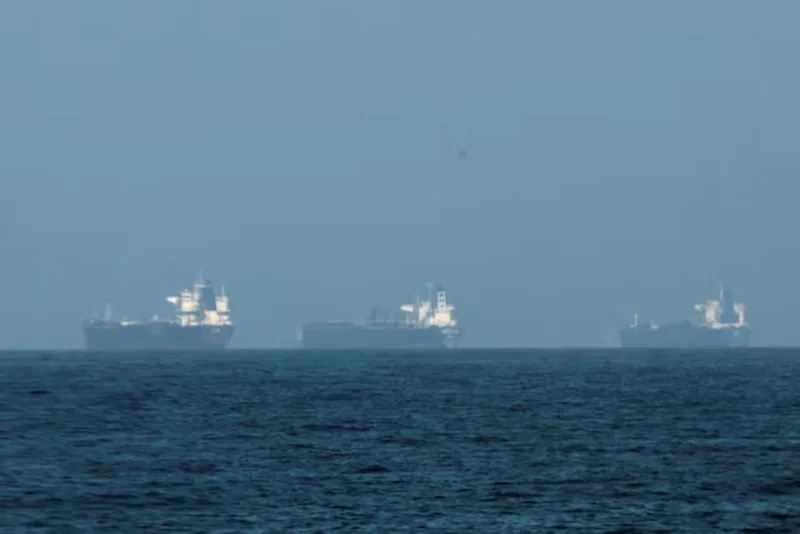
Iran has been effectively controlling the Strait of Hormuz, a key waterway for global oil shipping.
U.S. Central Command said the blockade would be “enforced impartially against vessels of all nations” entering or departing Iranian ports and coastal areas, including all Iranian ports on the Persian Gulf and Gulf of Oman.
It said it would still allow ships traveling between non-Iranian ports to transit the Strait of Hormuz.
Around a fifth of the world’s traded oil typically flows through the Strait of Hormuz every day. Saudi Arabia, Iraq, the United Arab Emirates, Kuwait, and Iran are all major exporters.
Traffic in the strait has been limited even in the days since the ceasefire. Marine trackers say over 40 commercial ships have crossed since the start of the ceasefire.
Claudio Galimberti, chief economist of Rystad Energy, said the blockade will raise prices but might move the needle on talks.
“It means the oil markets will be even tighter than before,” he said. “However, I think this is a negotiation tactic, which eventually resolves into a full opening of Hormuz. So, more pain now, but more gain later.”
However, Jim Krane, Energy Research Fellow at Rice University, said the blockade might be effective as a long-term strategy to impose pain on the Iranian economy, but it isn’t a good short-term negotiating tactic when the oil market is already under strain.
“If the deficit to the oil market takes another jump it is going to impose pain on every person on Earth that’s subject to market oil prices,” he said.
This report is given by Associated Press. The Sen Times holds no responsibility for its content.
What impact does the Iran blockade have on the world oil prices?
The obstructing of Iranian ports by the US results in an immediate supply shock, which causes the barrel of oil prices globally to skyrocket by the expected withdrawal of barrels of oil in Iran. Financial analysts affirm that such geopolitical shocks raise the risk premium, traders start taking into consideration a bigger volatility and reduced global spare capacity.
Will there be the closing of the Strait of Hormuz as early as Monday?
The U.S. Central Command believes that the Strait of Hormuz will be open to transit by non-Iranian ports but a localized embargo will be strictly followed regarding vessels entering or leaving Iranian waters. Although the strait remains not completely shut, the interdiction of Iranian coastal waters of Monday, selectively blocking marine traffic in the region.
How much is Brent crude going to cost after US blockade?
After the news of the US blockade, the prevailing price of Brent crude oil has got to 102.29 per barrel, which is 7 percent higher than the past sessions. This global index has displayed a lot of volatility during the war with a minimum of $70 at the start of war and maximum values of over 119.
What is the percentage of the world oil that goes through Strait of Hormuz?
About 20 percent of the globe petroleum liquids that are exchanged daily are through the Strait of Hormuz and it is the biggest maritime oil chokepoint worldwide. This small passageway helps in the export of crude and refined goods of key producers such as Saudi Arabia, Iraq, the United Arab Emirates and Kuwait.
Is this US blockade of Iranian ports a negotiating strategy?
Experts in the industry are split on the strategic purpose where some economists see the blockade as a high-stakes negotiation strategy aimed at compelling a total reopening of regional trade routes. On the other hand, Manoui, prominent energy research fellows say that the maneuver is a long-term economic containment policy that is aimed at putting the Iranian regime under a permanent financial strain.
How will the Iranian port closures affect consumers economically?
The financial implications of the closing of Iranian ports as a deficit jump in the world oil market translates to the rise of fuel prices and inflation pressure to the world market consumers. Energy studies have ruled that whenever the world supply is artificially reduced price explosion forms a direct inattainable financial pressure on any given economy which forgoes the energy price to the market price approach.