
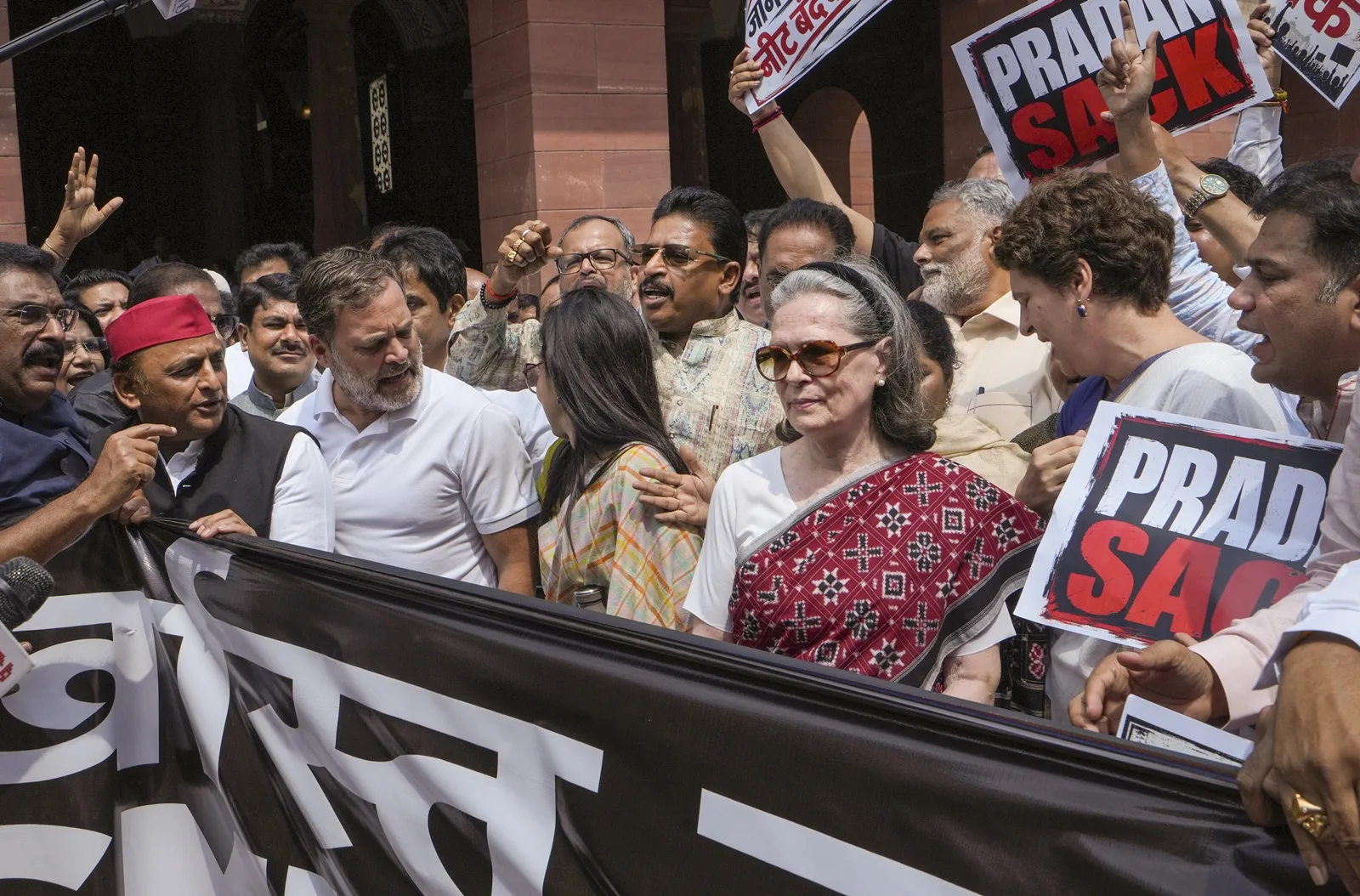
New Delhi, Jul 24 (PTI) In a broadside against the Modi government, Congress Parliamentary Party chairperson Sonia Gandhi on Friday said students have demanded accountability and educational reforms, but the Modi government has responded to their courage with “cowardice and wanton cruelty, treating them not as inheritors of the future but as enemies of the nation”.
She accused the government of degrading India’s education landscape and asserted that the country’s students have called the Modi regime’s bluff.
She emphasised it is a moral, political, and constitutional duty to stand with students and safeguard their future.
“The student protests are a natural consequence of these interrelated forces: today’s bleak education landscape, which evokes only hopelessness, and the Modi government’s trademark arrogance and unwillingness to be accountable or constructive,” Gandhi said in her article titled ‘An education system’s collapse, young India’s trauma’ published in The Hindu.
She claimed that the ‘brutality’ perpetrated by the police personnel functioning under the direct authority of the Union Home Minister on student protesters is hardly unprecedented for this regime.
“We all remember vividly how armed policemen and paramilitary forces ravaged university campuses during the Citizenship (Amendment) Act-National Register of Citizens protests in 2020. The unacceptable excesses against India’s women wrestlers can never be erased from our memories,” she said.
The Modi government has not just degraded India’s education landscape but has also made a habit of acting with “utter impunity, supreme self-delusion, and abject insensitivity”, she alleged.
She pointed out that peaceful protests by students across India against examination paper leaks and the overall decline in the education system have been gaining momentum in recent weeks.
“Their demands have been straightforward and to the point: accountability from the Government of India and education reform. The Narendra Modi government has responded to their courage with cowardice and wanton cruelty, treating them not as inheritors of the future but as enemies of the nation,” she said.
On July 20, 2026, which she described as a day of infamy, the Delhi Police and the Central Armed Police Forces (CAPF’s) sought to suppress them with violence, using lathicharges and tear gas, the former Congress chief said.
Gandhi noted that numerous peaceful protesters were injured, and even students heading home were not spared, as police used batons indiscriminately.
“The nation has seen some of the most depressing visuals of youth whose bodies have been scarred by pellets, the use of which would undoubtedly have been approved by Union Home Minister Amit Shah himself,” her article read.
“The videos from that day are seared into our memories and have stirred our collective conscience. Only the government and its captive media are spinning stories around this spontaneous rising tide of protest. It is time to say loud and clear: Stop, these are our sons and daughters, our young men and women,” Gandhi said.
Gandhi accused the Modi government of routinely choosing violence over dialogue.
“The pattern is clear, from farmers to activists. But this week, even a government as insensitive as the one that has set new standards of authoritarian governance sank to a new low. Instead of reaching out with understanding to our future doctors and engineers, teachers and civil servants, entrepreneurs and nation builders, it unleashed the repressive power of the state on them. This can neither be forgiven or forgotten,” Gandhi said.
She noted that the government’s old ‘toolkit’ of labelling dissent as anti-national has been repurposed to undermine the student protests.
The Modi government has reached deep into its bag of tricks to cast aspersions and peddle conspiracies when what it should have done is to introspect on its policies that have motivated the protests, Gandhi said.
She opined that the first fundamental issue is the Modi government’s retreat from public education. It has reduced the proportion of its total Budget spent on school education by 50% and on higher education by 33 per cent, she pointed out.
“Can anyone see the sense in such an absurd retreat? Over the last 12 years, the Modi government has shut down nearly one lakh public schools while overseeing the opening of 43,000 private schools — a large chunk of which are run by the Rashtriya Swayamsevak Sangh, which, along with its affiliate organisations, incidentally presides over the largest private school network in India,” she said.
With high-quality, affordable public education inaccessible, families in India have been forced to spend out of pocket to educate their children, Gandhi said.
“The total amount spent by families on the National Eligibility-cum-Entrance Test (NEET) examination coaching alone is as much as the Modi government invests in public education in total,” the Congress MP said.
The acute desperation of our students is a direct consequence of the privatisation and commercialisation of education, she argued.
Gandhi further said that the second issue is the gutting of India’s public examination system, which she alleged has undergone the processes of centralisation, privatisation, and politicisation.
The traditional practice of universities and States setting their own examinations to cater to their unique needs was replaced by a centralised, National Testing Agency (NTA)-conducted examinations such as the Common University Entrance Test (CUET), she pointed out.
“The NTA itself is a hapless, chronically understaffed body which relies entirely on an army of private contractors to conduct its examinations. It is also well known that the paper-setters, translators, and experts engaged by the NTA are not renowned academics from India’s premier institutions but are, for the most part, mediocre individuals with political affiliations,” she said.
The end result of this process has had stark consequences — 152 paper leaks occurring across the country in the past 12 years, including nine by the NTA itself since it was formed in 2017, Gandhi said.
The third issue is the difficulty of succeeding in India’s education system, she said, arguing that high-quality, well-paid job opportunities after graduation are a rarity today, partly due to the growing monopolisation of the economy.
“But the last nail in the coffin has been the Modi government’s consistent and conscious policy of evading accountability and avoiding good-faith conversations on education,” Gandhi asserted.
She accused Education Minister Dharmendra Pradhan of displaying contempt for accountability by publicly dismissing the Parliamentary Standing Committee on Education’s recommendations to strengthen the NTA, simply because it had members of the Opposition in it.
His unwillingness to resign from office despite these monumental failures has only further inflamed public opinion, Gandhi said.