

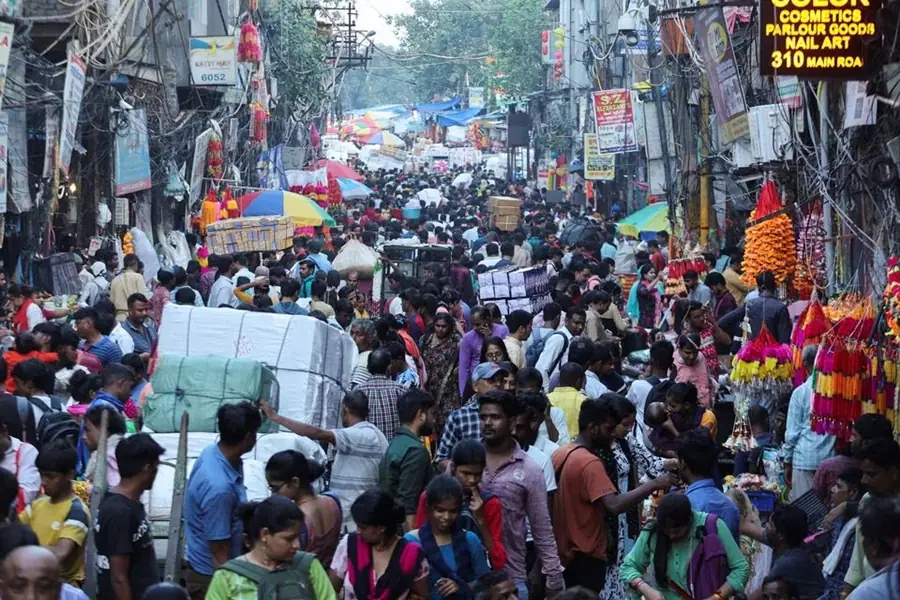
New Delhi (AP): India has begun the world’s largest national population count, which could reshape welfare programs and political representation across the country.
The previous census in 2011 recorded a population of 1.21 billion. It’s now estimated to be more than 1.4 billion, making India the most populous nation.
The new census had been planned for 2021 but was postponed due to the COVID-19 pandemic and logistical challenges.
Here’s how India’s census works and why it is significant:
Counting more than 1.4 billion people
The first phase of the count started Wednesday and will roll out around the country through September. The workers will spend about a month in each area collecting information on homes and available facilities and will document housing stock and living conditions.
The exercise will blend in-person surveys with a digital option where residents can submit information through a multilingual smartphone application that integrates satellite-based mapping.
The second phase to be conducted from September to next April 1 will record more detailed information like people’s social and economic characteristics, including religion and caste.
More than 3 million government workers are expected to be deployed over the course of the year. In 2011, nearly 2.7 million enumerators surveyed more than 240 million households nationwide.
A politically sensitive caste count
The second phase of the census will attempt a broader accounting of caste beyond historically marginalized groups.
Caste is an ancient system of social hierarchy in India and is influential in defining social standing and deciding who gets access to resources, education and economic opportunity. There are hundreds of caste groups based on occupation and economic status across India, particularly among Hindus, but the country has limited or outdated data on how many people belong to them.
The last attempt to gather detailed caste information through a census dates to 1931, during British colonial rule. Since independent India’s first census in 1951, it counted only Dalits and Adivasis, members of marginalized groups known as scheduled castes and tribes.
Successive governments have resisted conducting a full caste count, arguing it could heighten social tensions and trigger unrest.
Population data matters for India’s politics
Population data collected through the census underpins the distribution of government welfare programs and a wide range of public policies.
It could also prompt a redrawing of India’s political map, as seats in the lower house of Parliament and state legislatures may be increased to reflect population growth. A 2023 law reserves one-third of legislative seats for women, so any expansion would raise the number of seats set aside for female representatives.
This report is based on the Associated Press article written by Sheikh Saaliq. The Sen Times holds no responsibility for its content.
FAQs
How does the 2026 India Census process work for 1.4 billion people?
India’s 2026 Census is a two-phase national exercise utilizing 3 million government workers to document over 1.4 billion residents through digital and in-person surveys. The first phase focuses on housing stock and living conditions, while the second phase records detailed socio-economic characteristics, including religion and caste, using a multilingual smartphone application integrated with satellite-based mapping.
Why is the 2026 caste count considered politically sensitive?
The 2026 caste count represents the first attempt since 1931 to gather detailed data on hundreds of occupation-based groups beyond historically marginalized communities. This data is highly sensitive because it defines social standing and access to resources, potentially triggering social tensions or shifts in affirmative action policies across the country.
How will new population data impact India’s political representation?
New census data will trigger a “delimitation” process to redraw India’s political map, likely increasing the number of seats in the Parliament and state legislatures. Because legislative seats are proportional to population growth, the jump from 1.21 billion in 2011 to an estimated 1.4 billion today will significantly alter the balance of power between states.
What are the primary differences between the 2011 and 2026 India Census?
The 2026 Census marks a transition from purely paper-based records to a “Digital Census” that accounts for a population increase of nearly 200 million people. While the 2011 exercise surveyed 240 million households with 2.7 million workers, the 2026 effort has scaled to 3 million workers to manage India’s new status as the world’s most populous nation.