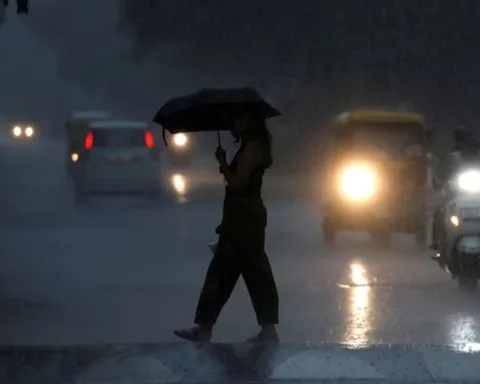


New Delhi, April 13 (Reuters) – India is likely to see below-average monsoon rains for the first time in three years in 2026, the government said on Monday, stoking concerns over farm output and growth in Asia’s third-largest economy as it battles inflation driven by the Iran war.
The monsoon, which typically arrives over the southern state of Kerala around June 1 and retreats by mid-September, is expected to reach 92% of the long-period average this year, M. Ravichandran, secretary in the Ministry of Earth Sciences, told a news conference.
Make sense of the latest ESG trends affecting companies and governments with the Reuters Sustainable Switch newsletter. Sign up here.
The India Meteorological Department defines normal rainfall as between 96% and 104% of a 50-year average of 87 cm (35 inches) for the four-month season.
This report is given by Reuters The Sen Times holds no responsibility for its content.
How come the 2026 monsoon is below average?
India is expected to have the first under average monsoon in three years with the rainfall likely to be 92% of the long period average. This shortfall has mainly been caused by changing climatic trends that are posing the threat of impacting the four months cycle of precipitation that begins in June.
What effects will the Iran war have on Indian inflation 2026?
The current war in Iran is one of the major triggers behind the increased inflation in India which raises the tensions of the Indian economy in the light of the estimated rainfall shortfall. Such political turmoil at the geopolitical level is disrupting the global supply chains and energy prices, putting the third-largest economy in Asia in a volatile situation.
How soon will monsoon come to Kerala in 2026?
The monsoon has been customarily predicted to hit against the coastal state of Kerala around June 1, the official date of beginning of the rainy season. It is then anticipated to move over the subcontinent after which it starts retreating in mid-September.
What is the Indian rain-fall average that is long-period?
Generally the long-period average (LPA) of Indian rainfall is fixed to 87 cm (35 inches), a 50-year historical mean. This reference is the objective reality of the classification of the performance and sufficiency of annual monsoon season.
What is the impact of a below normal rain on the GDP growth of India?
Monsoon rainfall below normal will have direct detrimental effect on GDP growth of India as it decreases the overall farm production and diminishes the buying capacity of the rural population. As a large chunk of the Indian agriculture relies on withdrawal, a fall of contract precipitation has a contractionary impact in the larger economy.
Of LPA 92 percent India monsoon?
India monsoon at 92-percent LPA means that it is a below-normal season, which is below 96 percent that is known to indicate a normal season. The particular percentage denotes that there is a big difference to the 50 years average of 87 cm, which is an indicator of water scarcity.