
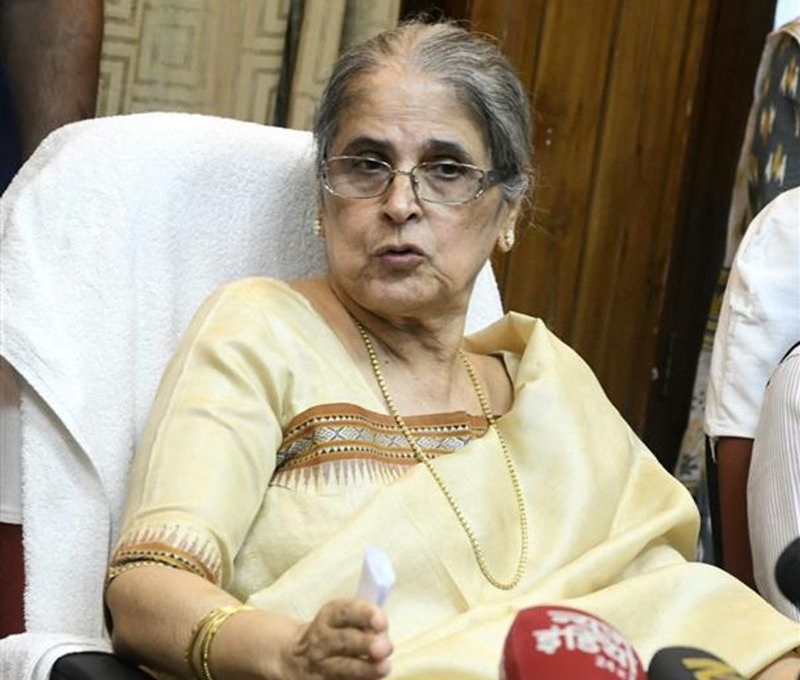
The central government has given the green light to the terms of reference (TOR) for the 8th Pay Commission. They have also named Justice Ranjana Prakash Desai, a former Supreme Court judge, as the chairperson of the Commission. The commission will now start preparing its report and will submit it in the next 18 months. The report will go to the Union Cabinet for review and approval.
When the Cabinet approves a pay commission’s recommendations, it also signs off on the fitment factor, which is a multiplier for salary and pension revisions for central government employees and pensioners.
Terms of Reference approved by Govt; check what it is and how it impacts salaries, pensions
According to a statement from the Ministry of Finance, the 8th CPC will be a temporary body, comprising one chairperson, one member (part time) and one member-secretary.
The Finance Ministry also said that the new pay commission will deliver its recommendations within 18 months of the date of its constitution. The recommendations will be submitted to the Union Cabinet, which can suggest some changes in them. Once the Union Cabinet gives its approval, the recommendations of the 8th Pay Commission will be implemented, impacting the salaries, allowances and pensions of central government employees and pensioners.
What are the “Terms of Reference” (ToR) in a Pay Commission, and why are they important?
TOR is like a rule book for a pay commission, based on which the commission prepares its report. TOR has definitions, terms and conditions used as a reference for preparing a pay commission report.
Who drafts and approves the Terms of Reference?
A Joint Consultative Machinery (JCM) drafts Terms of Reference (TOR) of a pay commission, and the Cabinet Committee under the Finance Ministry approves it. The JCM has employee union representatives from each ministry. Out of 60 JCM members, 12 are selected for the standing committee. These 12 members discuss TOR topics with secretary-level government employees. Once finalised, TOR goes to the Cabinet for approval.
The JCM doesn’t have members from Union territories, and pay commission members talk to UT representatives separately.
Does the Cabinet approve all TORs?
If the Cabinet wants, it can decline some TORs or ask the members to modify them.
How does ToR decide the scope of what the Pay Commission can or cannot recommend?
TOR is important as it becomes the reference point when a pay commission prepares its report. But a pay commission has the power to discuss matters outside of TOR. However, it doesn’t happen very often.
What are Terms of Reference (TOR) for the 8th Pay Commission (8th CPC)?
In an unstarred question by Bhubaneswar Kalita, Member of Parliament, on July 22, 2025, Pankaj Choudhary, Minister of State, Ministry of Finance, presented the Terms of Reference for the 8th CPC forwarded by Secretary Staff Side NC(JCM) through the Department of Personnel & Training. The TOR presented by him were as follows-
A. To examine the existing structure of pay, Allowances and other benefits/facilities, retirement benefits like pension/gratuity and other terminals benefits etc. to the following categories of employees:-
1. Central Government employees-industrial and non-industrial.
2. Personnel belonging to All India services.
3. Personnel belonging to the Defence Forces and Para Military Forces.
4. Personnel called as Grameen Dak Sewaks belonging to the Postal Department.
5. Personnel of Union Territories.
6. Officers and employees of the Indian Audit and Accounts Department.
7. Officers and employees of the Supreme Court.
8. Members of Regulatory bodies (excluding RBI) set up under Act of Parliament.
9. Employees of Central Government Autonomous Bodies and Institutions.
B. To work out the comprehensive revised pay packet for the categories of Central Government Employees mentioned in (A)above as on 1.1.2026.
C. The commission will determine the pay structure, benefits, facilities retirement benefits, welfare matters etc taking in to account to provide the minimum wage as a “Decent and dignified Living Wage” with reference to the recommendation of the 15th Indian Labour Conference (1957) with modifications in the Dr. Aykroyd formula, considering the developments and life requirements which has undergone changes in last 65 years as well as various Supreme Court judgments on fixing the minimum wages as on 1.1.2026. The commission will also consider increasing the consumption units from 03 family units to 3.6 family units as recommended by an expert committee constituted by the Ministry of Labour and Employment to determine the National Minimum Wage Policy in the year 2019.
D. The 8th CPC should consider the merger of non-viable pay scales such as Level -1 with Level-2 and Level-3 with Level-4 and Level-5 with Level-6.
E. To consider the existing anomalies in the MACP scheme and to recommend minimum 3 promotions in service with very defined hierarchical structure and MACP in the promotional hierarchy.
F. To determine the Interim Relief to be sanctioned immediately to the central government employees and pensioners mentioned in (A) above.
G. To determine the percentage of Dearness Allowance / Dearness Relief immediately to be merged with Pay & Pension.
H. To settle the various 7th CPC Anomalies which the Staff Side raised in the Anomaly Committee meetings and JCM meetings.
I. To Workout the improvements needed to the existing retirement benefits like pension, Death cum retirement Gratuity, Family pension, restoration of commuted portion of pension after 12 years, implementation of Parliamentary Standing Committee recommendations for enhancement of pension after every 5 years, parity amongst past and future pensioners.
J. To review and to restore the defined and non contributory Pension Scheme Under CCS (Pension Rules) 1972 (Now 2021) to the Central Government employees recruited on or after 1/1/2004.
K. To recommend the parliamentary Standing Committee recommendation on CGHS related matter FMA and to recommend methods for providing cashless /hassle-free Medical facilities to the employees and Pensioners including Postal Pensioners.
L. To review and recommend Children Education Allowance and Hostel Subsidy up to the Post Graduation Level.
M. To review and recommend introduction of such advances which are required in the current circumstance and also to restore the advance which are abolished.
N. To consider payment of risk and hardship allowance to all categories of Railway employees in the Indian Railways, considering the risk and hardship involved in the nature of duties of the Railway employees who work round the clock on all 365 days.
O. To consider the highly, perennial, risky and hazardous working conditions under which the Defence Civilian Employees involved in manufacturing arms, ammunitions, chemicals, explosives & acids etc., and also in its storage and to recommend a Special Risk Allowance, Insurance coverage, compensation etc.
The fitment factor in the 7th Pay Commission was 2.57, and it will take a while to find out what will be the fitment factor for the 8th Pay Commission. But how does the fitment factor determine salaries and pensions? How is it decided? Does dearness allowance (DA) also have a role in figuring out the fitment factor? And what happens to salaries and pensions if the fitment factor for the 8th Pay Commission is set at 2.0? Let’s break it down in this write-up.
8th Pay Commission: How the fitment factor impacts salary and other allowances
An employee’s basic salary as per the previous pay commission is multiplied by the fitment factor to determine the basic pay in the new pay commission. For example, if a person is getting Rs 35,000 basic pay and the new fitment factor is 2.11, then the new basic salary will be Rs 73,850.
The fitment factor decides how much salaries will rise across different pay matrix levels. It is expected to range between 1.83 and 2.46. A higher factor means better take-home pay for employees and larger pensions for retirees. By aligning pay with current inflation and living costs, the 8th Central Pay Commission could become one of the most generous in recent times.
The allowances such as HRA, which are calculated as a percentage of basic pay, will automatically increase once the new basic is notified. Fixed allowances like transport allowance are usually reviewed separately and may be revised within a few months after the 8th Pay Commission’s recommendations are implemented.
Does dearness allowance (DA) play a role in determining the fitment factor?
The dearness allowance of an employee doesn’t directly decide the fitment factor, but when a pay commission decides on the fitment factor, the DA rate, which is calculated on the basis of the basic pay, is also one of the key factors.
For example, the current DA is 58% and there is a 12% increase in DA by the time the recommendations of the 8th Pay Commission are implemented, DA will reach 70%. Above that, the government calculates the growth factor, which was 24% last time. While calculating the fitment factor, the pay commission also considers family units, which was 3 last time and can be 4 this time. If the commission considers 4 family units, another 13% increase is expected. So, the fitment factor is a mix of these things.
Can the overall salary be double because of the fitment factor?
The impact of the fitment factor is on the basic salary and HRA, but at the same time, DA becomes zero in a new pay commission. So overall, the salary may increase by 20-25%.
Is fitment the same for all central government employees?
A uniform factor of 2.57 was applied across all levels in the 7th Pay Commission. The government may continue this uniform approach for simplicity, though a slightly higher multiplier for lower pay bands could be considered to narrow wage disparities.
The employees at high pay levels get more chances of promotion compared to employees at lower levels. So, the pay commission may keep a high fitment factor for low-level employees and a low fitment factor for high-level employees. It may also merge some pay levels to simplify the pay matrix process.
At present, there are 18 pay levels for central government employees.
What will be the revised salary of a central government employee with basic pay of Rs 50,000 at a 2.0 fitment factor?
For example, if an employee earns a basic pay of Rs 50,000 under the 7th Pay Commission, and the 8th Pay Commission recommends a fitment factor of 2.0, the new basic will simply double — Rs 50,000 × 2.0 = Rs 1,00,000. The revised pay matrix will then place the employee at the nearest higher cell. Allowances like DA, HRA and transport allowance will subsequently be recalculated on this new basic salary.
How will the 8th Pay Commission impact central government pensioners?
The central government pensioners usually get a corresponding revision based on the same fitment factor. So, if the factor is 2.0, a pensioner drawing Rs 30,000 would see the basic pension rise to about Rs 60,000, subject to rounding and approval.