

THE ESSENTIALS
- September 15th is International Democracy Day.
- There are forms of direct democracy in the world: in Switzerland, in Uruguay, in a dozen American states or even in the state of Bavaria in Germany, for example.
- Citizens do not make all political decisions, but no institution can wield power beyond their control. Petitions and referendums are the tools that allow for the direct expression of the people in modern democracies .
At a time when direct democracy is generating increasing interest , the term produces as much hope as confusion.
For some , direct democracy refers to a regime that only existed in the time of Socrates and Demosthenes and that has become impossible in contemporary societies.
For others, referendum procedures are in themselves tools of direct democracy, even if, wherever they exist, they are generally associated with representative institutions. This is why regimes, like Switzerland, which make extensive use of referendums, are sometimes described as “semi-direct democracies” : popular initiatives and referendums coexist there with a Parliament, a government, and other representative institutions.
Finally, direct democracy is often confused with participatory democracy, which is embodied in mechanisms such as citizens’ assemblies or participatory budgets.
Our aim here is to define what direct democracy is and to show which current political regimes can be classified in this category. We also aim to distinguish direct democracy from its instruments – referendums, petitions, assemblies, etc. – and to present the main existing examples.
Direct democracy: definition
A direct democracy is a system in which all citizens make political decisions. This is, in a way, a pleonasm : the etymological definition of democracy – the power of the people – corresponds to the idea of a system in which citizens govern themselves directly.
At the end of the 18th century, during the American and French Revolutions, the term “democracy” was used to designate this system in which citizens governed themselves. Over time, as representative regimes came to be known as “representative democracies ,” the adjective “direct” had to be added to the word “democracy” to avoid confusion.
This definition is sometimes wrongly interpreted as meaning that a direct democracy cannot include a Parliament, a government, or, more generally, representatives.
However, this is not what is implied by the idea that citizens make political decisions together. It does not mean that citizens must make all decisions themselves. It means that no institution can ultimately possess power that escapes citizen control.
Our representative systems, for example, make Parliament the ultimate body where legislative decisions are made. But many decisions are made without Parliament’s direct involvement: the government, administrative bodies, and judges make decisions on behalf of the public every day. They, too, thus perform representative functions. However, these decisions remain subject to the authority of Parliament: government actions can be overturned by law, and administrative or judicial decisions can be modified by the legislature. Our political system is therefore a complex set of institutions in which Parliament ultimately has the final say.
Similarly, a direct democracy is a complex set of institutions in which citizens, through their direct expression, have the final say . It is therefore perfectly compatible with a parliament, a government, and other representative institutions. What changes is the institution at the top of this set: in a representative democracy, it is the representative institutions; in a direct democracy, it is the citizens themselves.
Petitions and referendums: modern instruments of direct democracy
What, concretely, does a decision taken directly by the people consist of?
Two elements are necessary. First, a right of initiative : citizens must be able to propose changes to political rules themselves. Second, a right of veto : they must be able to accept or reject decisions made by representative institutions.
As long as citizens possess these two rights, and regardless of any other existing institutions, the political system can be described as a direct democracy. This definition, which I have defended in several academic texts , allows us to distinguish between regimes that are, strictly speaking, direct democracies and representative regimes that grant citizens a prominent role.
What remains unclear in such a definition are the concrete institutions that allow citizens to exercise these rights.
One might consider, for example, the Athenian Ecclesia , where all Athenian citizens gathered and had both the right to propose laws and to vote on them. Although the Pnyx—the esplanade where these large assemblies were held—was vast, it is difficult to imagine densely populated countries functioning in this way. This is the type of system that those who believe direct democracy is only possible in small countries have in mind.
However, as early as the 18th century, a simple method was found to make direct democracy compatible with densely populated states. Any citizen can initiate a legislative procedure by means of a petition gathering the required number of signatures. Once this threshold is reached, all citizens can accept or reject the proposal by referendum.
Petitions and referendums are therefore the modern instruments that allow direct democracy to function in large and populated states.
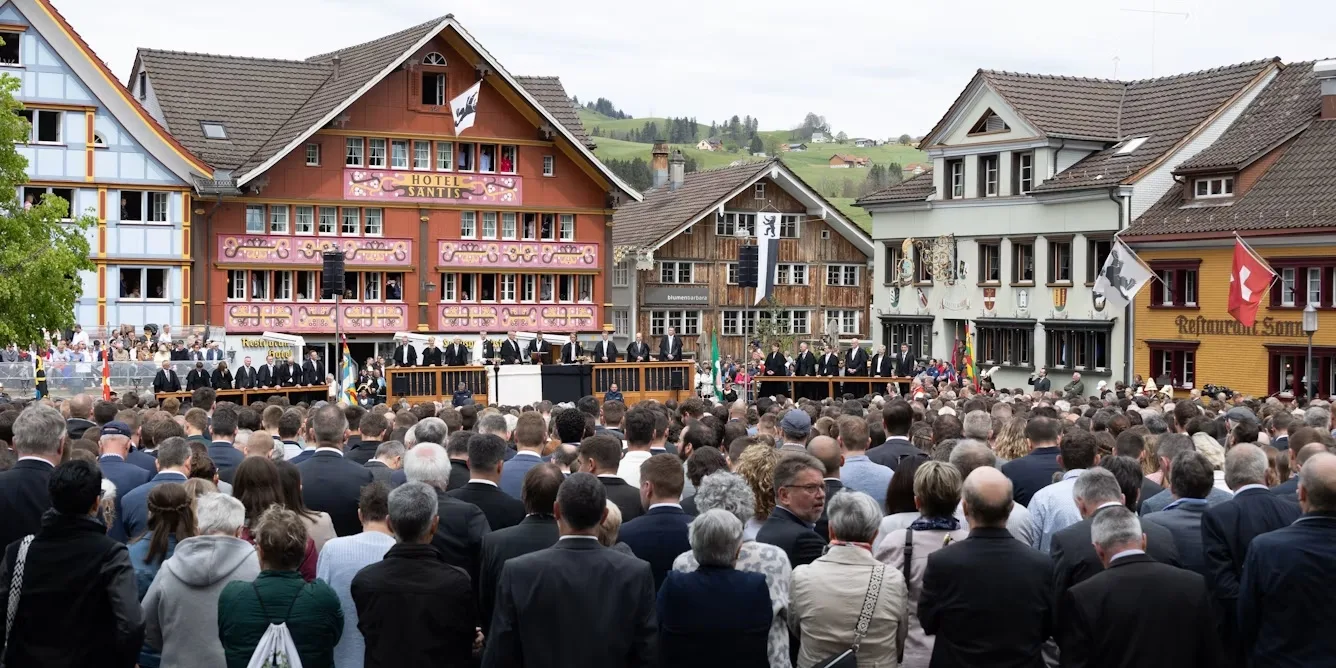
Thanks to this mechanism, direct democracy functions today in both large and small communities, at the local and national levels. It is true that very small communities can still make use of assemblies. The Swiss canton of Glarus, for example—whose citizen population is roughly comparable to that of ancient Athens—still practices direct democracy in its traditional form .
But it is equally true that most communities that practice direct democracy, including those less populated than Athens, prefer to use petitions and referendums rather than bringing all citizens together in one place.
In reality, it is precisely this model based on petitions and referendums that has become widespread and has become the characteristic institution of modern direct democracy .
But while petitions and referendums are indeed instruments used by direct democracies, they can also be used outside of direct democracy.
In France, for example, the president can call referendums, but this gives citizens neither a right of initiative—since it is the president who decides whether to put a question to a vote—nor a right of veto—no law is required to be submitted to a public vote. Similarly, there is a right of petition enshrined in the Constitution and regulated by law, but this does not give citizens the power to submit a bill to a vote by the entire electorate.
In fact, a referendum is only an instrument of direct democracy if it gives citizens the opportunity to reject laws they wish to challenge. A petition is only an instrument of direct democracy if it allows a proposed law to be submitted to the entire electorate.
In other words, referendums and petitions are not sufficient in themselves: it is the way they are organized that determines whether they actually give citizens direct decision-making power.
This is also true for parliaments. Many dictatorships have parliaments and hold referendums. But they are neither representative regimes nor direct democracies.
Examples of direct democracies around the world
Political regimes that fit the above definition are rare, but they do exist.
The best-known example is Switzerland : citizens have a right of veto over all laws – notably through mandatory and optional referendums – and a right of popular initiative. If the required number of citizens support a proposal, it is put to a popular vote and, if accepted, it is directly incorporated into the Constitution.
Naturally, as with all political systems, Switzerland has many other institutions and rules, as well as a Parliament and a government. But what is important to remember is that the final decision always rests with the Swiss citizens.
Uruguay shares this characteristic. The signature thresholds are higher, the rules are slightly different , and, above all, the representative institutions are very different, as it is a presidential system. However, in this country, citizens have the final say on all decisions and can initiate legislation. Often called the “Switzerland of Latin America,” primarily due to its economic stability, Uruguay is especially renowned for its political institutions.
Several small states are also direct democracies. Palau, Micronesia, and the Marshall Islands are among them. Liechtenstein comes very close, despite the existence of a veto by the prince, which applies to all referendums except those concerning his removal from office.
Taiwan is in transition to a direct democracy , while the Philippines is a particularly interesting example of a failed direct democracy : citizens have the right to initiate and veto, but the conditions necessary for their exercise are so difficult to meet that they do not allow the people to exercise these rights.
To date, no other sovereign state meets the conditions to be classified in this category, although many states use petitions and referendums in different ways.
Beyond sovereign states, direct democracy is also very active in certain American states where citizens have mechanisms that allow them to exert influence over representative institutions. These include California , Colorado , Oregon , Arizona, and 12 other states . This system, which has existed for over a century, has significantly contributed to shaping the political life of these states.
In Germany, Bavaria can also be described as a direct democracy. Citizens there control all constitutional amendments. Certain decisions are excluded from referendum, such as the state budget, but these limitations are themselves enshrined in the Constitution and can be modified through constitutional revision procedures.
This is a crucial point: direct democracy does not mean that citizens must decide directly on all public affairs. It means that citizens ultimately remain in control of the extent of the powers they exercise themselves and those they entrust to representative institutions.
Direct democracy is therefore neither a utopia nor a fantasy. It is a complex and stable political system, admittedly rare, but very real and well-studied. It functions differently from representative democracy and does not produce the same effects . These effects, which we have studied in a collective work , include a reduction in public debt and the size of the state, greater citizen competence, greater trust in institutions, and a reduction in conflicts.
Source – Raul Magni-Berton, Professor of Political Science, AnthropoLab – Ethics, Catholic Institute of Lille (ICL)