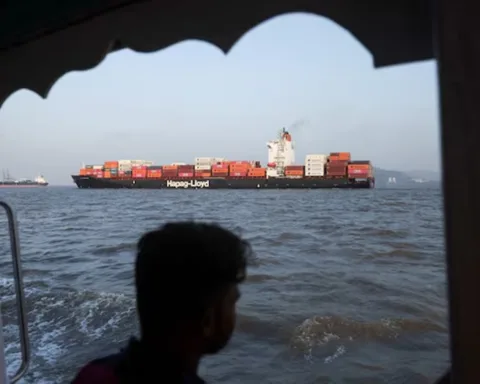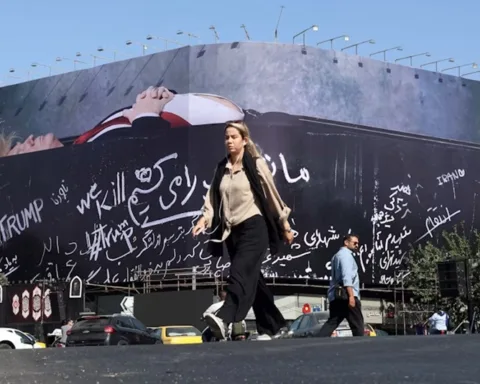

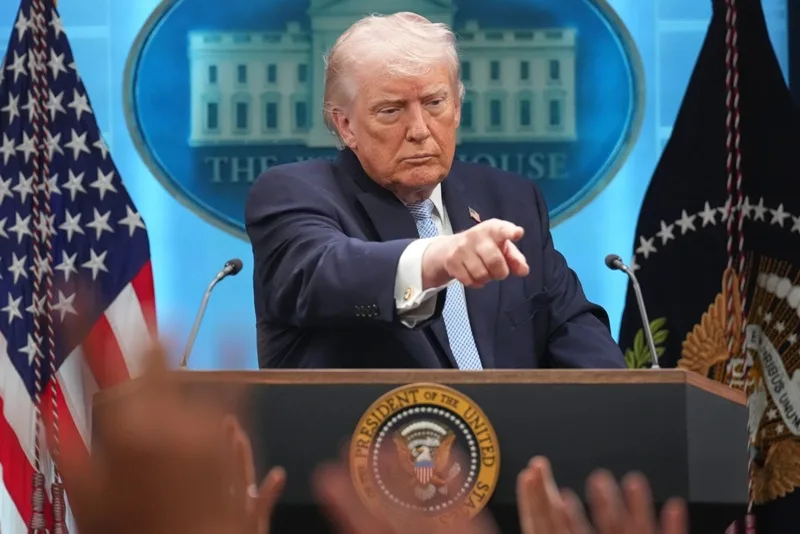
WASHINGTON, April 7, 2026 (AP) — President Donald Trump has pushed back a deadline for Iran to cut a deal or open the Strait of Hormuz from Monday to Tuesday, the latest of several deadline delays, and threatened that without a deal “Hell will reign down on them.”
Trump’s previous deadline was for March 23, but that shifted several times over the ensuing weeks as Trump oscillated between heated threats, announced delays and proclamations that the negotiations were going well, sometimes in the same statement.
Iran rejected the latest ceasefire proposal, the country’s state-run IRNA news agency reported Monday. Shortly after, Trump gave an ominous warning to Iran if it didn’t capitulate, and suggested Tuesday’s 8 p.m. deadline was final.
“They’ll have no bridges. They’ll have no power plants. They’ll have no anything,” he said.
U.N. Secretary-General António Guterres warned the U.S. that attacks on civilian infrastructure is banned under international law, according to his spokesperson. Trump, speaking with reporters, said he’s “not at all” concerned about committing war crimes with such attacks.
Here are some of Trump’s deadlines and threats, and what happened next.
Table of Contents
An ultimatum about reopening the Strait of Hormuz
On March 21, Trump posted on Truth Social that if Iran doesn’t “FULLY OPEN, WITHOUT THREAT, the Strait of Hormuz, within 48 HOURS from this exact point in time, the United States of America will hit and obliterate their various POWER PLANTS.”
Iran had until the evening of March 23.
Then 12 hours before the deadline, Trump took to Truth Social to share the good news: that both countries had productive conversations toward concluding the conflict.
“I HAVE INSTRUCTED THE DEPARTMENT OF WAR TO POSTPONE ANY AND ALL MILITARY STRIKES AGAINST IRANIAN POWER PLANTS AND ENERGY INFRASTRUCTURE FOR A FIVE DAY PERIOD,” he wrote, adding that was subject to the success of the discussions.
That pushed the deadline out to the end of that week.
A threat to target desalinization plants
Before the deadline, on March 26, Trump doubled down on his threats on Truth Social: “They better get serious soon, before it is too late, because once that happens, there is NO TURNING BACK, and it won’t be pretty!”
But later that day, he extended the deadline for another 10 days, to April 6 at 8 p.m., and said on Truth Social that negotiations were “going very well.”
On March 30, Trump put out a mixed statement: celebrating progress in the talks with Iran while also expanding his threatened bombing if a deal wasn’t “shortly reached,” adding that “it probably will be.”
“We will conclude our lovely ‘stay’ in Iran by blowing up and completely obliterating all of their Electric Generating Plants, Oil Wells and Kharg Island (and possibly all desalinization plants!),” he wrote.
It’s unclear how soon “shortly reached” meant for Trump, but a deal was not made as the deadline loomed.
An expletive-filled threat to attack power plants and bridges
“Remember when I gave Iran ten days to MAKE A DEAL or OPEN UP THE HORMUZ STRAIT,” Trump said in a Truth Social post on Saturday, “Time is running out – 48 hours before all Hell will reign down on them.”
As the deadline approached, his posts had doubled down on his threats until Sunday, when Trump pushed the deadline again in an expletive-filled post.
“Tuesday will be Power Plant Day, and Bridge Day, all wrapped up in one, in Iran. There will be nothing like it!!! Open the F——-in’ Strait, you crazy bastards, or you’ll be living in Hell,” Trump said on Truth Social, followed by another post that specified 8 p.m. as the deadline.
Trump then suggested on Monday that Tuesday’s deadline would be final, saying he’d already given Iran enough extensions.
“The entire country can be taken out in one night, and that night might be tomorrow night,” Trump said. “We have a plan, because of the power of our military, where every bridge in Iran will be decimated by 12 o’clock tomorrow night.”
What’s next for diplomacy with Iran?
Mojtaba Ferdousi Pour, head of Iran’s diplomatic mission in Cairo, said Iran no longer trusts the Trump administration after the U.S. bombed the Islamic Republic twice during previous rounds of talks.
“We only accept an end of the war with guarantees that we won’t be attacked again,” he told The Associated Press.
A regional official involved in the talks said efforts had not collapsed. “We are still talking to both sides,” he said, speaking on condition of anonymity to discuss closed-door diplomacy.
On an Israeli TV station, Channel 13, the evening newscast showed a large digital clock counting down the hours and minutes to Tuesday’s deadline.
This report is given by Associated Press. The Sen Times holds no responsibility for its content.
How has the deadline for the Strait of Hormuz reopening evolved?
Research indicates a pattern of repetitive deadline extensions, shifting from an initial March 23 ultimatum to the current April 7 target. President Trump has consistently delayed kinetic action, moving the timeline four times while alternating between aggressive rhetoric and claims of productive diplomatic negotiations with Tehran.
What specific Iranian infrastructure is targeted in the U.S. threats?
President Trump has explicitly identified electrical generating plants, oil wells, bridges, and desalinization facilities as primary targets for potential aerial bombardment. The stated objective is the total decimation of Iran’s energy and transport networks to compel compliance with U.S. maritime and nuclear demands.
Is the targeting of Iranian civilian infrastructure a war crime?
International law, specifically the Geneva Conventions, prohibits direct attacks on civilian objects such as power plants and bridges unless they offer a distinct military advantage. While the U.N. has issued formal warnings regarding these mandates, the U.S. administration has signaled a policy of total infrastructure degradation to achieve strategic objectives.
Why is Kharg Island a primary target in U.S. military planning?
Kharg Island serves as Iran’s principal maritime oil terminal, processing over 90% of the nation’s crude oil exports. Eliminating this facility would effectively sever Tehran’s primary revenue stream, inducing an immediate economic collapse and neutralizing the country’s ability to fund prolonged regional military operations.