
WASHINGTON/JERUSALEM/CAIRO, April 1 (Reuters): President Donald Trump said the United States could end its military attacks on Iran within two to three weeks and Tehran did not have to make a deal as a prerequisite for the conflict to wind down.
The remarks underscored the shifting and at times contradictory statements from Washington about how the war, now in its fifth week, might end.
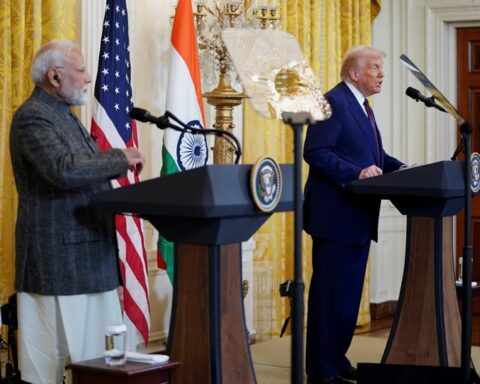
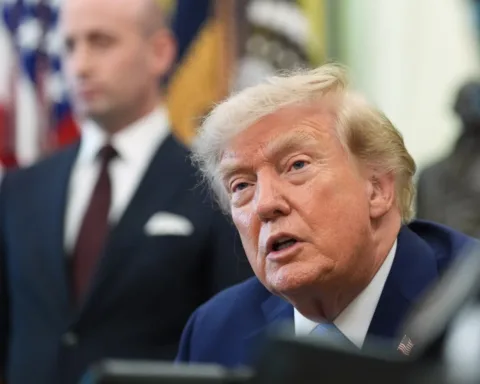
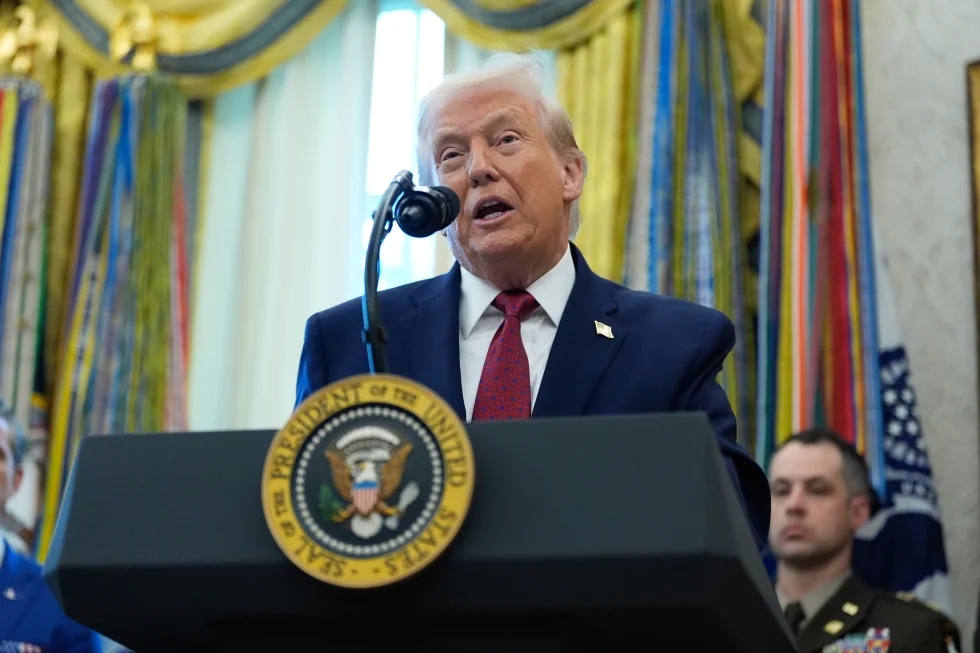
“We’ll be leaving very soon,” Donald Trump told reporters at the White House on Tuesday, saying the exit could take place “within two weeks, maybe two weeks, maybe three.”
Asked if successful diplomacy with Iran was a prerequisite for the U.S. to conclude what it has dubbed “Operation Epic Fury”, Donald Trump said it was not.
“Iran doesn’t have to make a deal, no,” he said. “No, they don’t have to make a deal with me.”
The White House later said Donald Trump would address the nation “to provide an important update on Iran” at 9 p.m. EDT on Wednesday (0100 GMT on Thursday).
Washington previously threatened to intensify military operations if Tehran did not accept a 15-point U.S. ceasefire framework that had among its core demands that Iran commit not to pursue nuclear weapons, halt all uranium enrichment and fully reopen the Strait of Hormuz.
Earlier on Tuesday, U.S. Defense Secretary Pete Hegseth said Donald Trump was willing to make a deal with Iran to end the war that has killed thousands, spread across the region, disrupted energy supplies and threatened to send the global economy into a tailspin.
The United Arab Emirates is preparing to help the U.S. and allies open the Strait of Hormuz by force, the Wall Street Journal reported late on Tuesday, in an effort to end the effective closure of the shipping lane through which about a fifth of the world’s daily oil and liquefied natural gas supply usually passes.
The UAE is seeking a U.N. Security Council resolution for the action and suggested the U.S. occupy strategic islands, according to the report.
While the United States has said talks with Iran were ongoing, Iranian Foreign Minister Abbas Araqchi said on Tuesday that he has been receiving direct messages from U.S. special envoy Steve Witkoff but they do not constitute “negotiations”, Qatar’s Al Jazeera TV cited him as saying.
The messages include threats or exchanged views delivered through “friends,” he added.
Iran’s Revolutionary Guards on Tuesday hit back with a new threat against U.S. companies in the region starting on Wednesday.
It listed 18 businesses including Microsoft (MSFT.O) Google (GOOGL.O), Apple (AAPL.O), Intel (INTC.O), IBM (IBM.N), Tesla (TSLA.O) and Boeing (BA.N) that would be targeted from 8 p.m. Tehran time (1630 GMT).
When asked if he was concerned about threats to the companies, Donald Trump said no.
Donald Trump earlier on Tuesday also criticized countries that have not helped the U.S. war effort, such as NATO member Britain.
“NATO is a one-way street,” Secretary of State Marco Rubio told Fox News Channel’s “Hannity” program, noting that Europe was eager for the U.S. to defend it but had not stepped up to provide the help the U.S. sought.
“After this conflict is concluded, we are going to have to reexamine that relationship,” Rubio said, while stressing that Washington “could see the finish line” in the war.
War Continues to rage
The war has also revived conflict between Israel and the Iran-backed Lebanese group Hezbollah.
At least seven people were killed and 24 wounded in two Israeli strikes in the Beirut area, the Lebanese health ministry said on Wednesday, in attacks that hit vehicles in Beirut’s southern outskirts and in an area just south of the capital.
Israel’s military said on Wednesday it carried out two separate strikes targeting a senior Hezbollah commander and another senior member of the Iran-aligned group in the Beirut area. It did not identify them or say whether they had been killed.
There was no immediate comment from Hezbollah on the strikes.
With the conflict in the Middle East showing no sign of easing, Pakistan is seeking to mediate in the war.
The foreign ministers of China and Pakistan on Tuesday called for an immediate ceasefire, urging peace talks to be held as soon as possible after they met in Beijing.
Iran has remained defiant despite heavy U.S. and Israeli attacks for the past month, as neighbors have been pulled into the conflict.
Syrian state television reported that explosions heard in Damascus were the result of Israeli air defences intercepting Iranian missiles.
A weather station’s radar and building in the Iranian port of Bushehr were put out of service on Tuesday after being hit twice in U.S.-Israeli attacks, a regional official told state media.
The Mobarakeh steel plant in the central city of Isfahan was attacked for the second time in a week, according to the semi-official Tasnim news agency, and parts of the Sefiddasht Steel Complex in the city of Borujen were targeted, according to the Fars news agency.
Reuters could not immediately verify the battlefield reports.
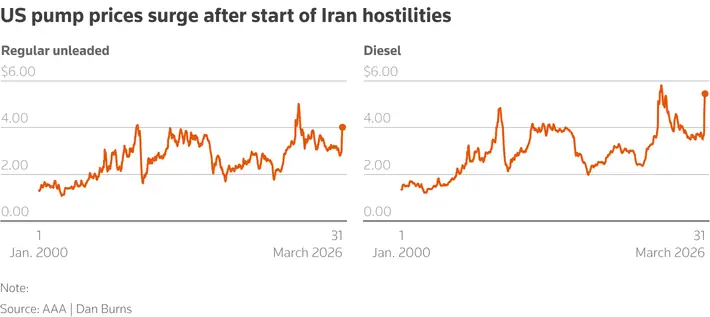
Higher oil and fuel prices have started to weigh on U.S. household finances and are a political headache for Donald Trump and his Republican Party before the November midterm elections.
The U.S. national average retail price of gasoline crossed $4 a gallon for the first time in over three years on Monday, data from price-tracking service GasBuddy showed.
Two-thirds of Americans believe the U.S. should work to end its involvement in the Iran war quickly, even if that means not achieving the goals set out by the Donald Trump administration, a Reuters/Ipsos poll found.
This report is given by Reuters. The Sen Times holds no responsibility for its content.
FAQs
When will the United States military presence in Iran end?
President Donald Trump indicates that U.S. military operations, titled Operation Epic Fury, could conclude within two to three weeks. This timeline suggests a rapid withdrawal of forces from the region, potentially ending the five-week-old conflict by mid-April 2026 regardless of a formal diplomatic agreement.
Is a diplomatic deal with Tehran required for a U.S. withdrawal?
A formal diplomatic treaty or ceasefire agreement is not a prerequisite for the cessation of U.S. hostilities. While a 15-point framework exists—demanding uranium enrichment cessation and the reopening of the Strait of Hormuz—the administration maintains the authority to conclude operations unilaterally based on internal timelines.
How is the conflict impacting the global economy and energy markets?
The effective closure of the Strait of Hormuz has disrupted approximately 20% of the world’s daily oil and liquefied natural gas supply, driving U.S. gasoline prices above $4 per gallon. This maritime blockade threatens a global recession, prompting calls for international intervention to restore trade flow.
What is the current status of regional escalations involving Hezbollah and Israel?
Kinetic activity has intensified along the Lebanese front, with Israeli Defense Forces conducting targeted strikes against senior Hezbollah leadership in the Beirut area. These operations are a direct response to the broader regional instability triggered by the ongoing U.S.-Iran confrontation.
What demands are included in the U.S. 15-point ceasefire framework?
The U.S. ceasefire framework requires Iran to cease all uranium enrichment, permanently abandon its pursuit of nuclear weapons, and fully reopen the Strait of Hormuz to international shipping. These demands serve as the primary conditions for a permanent cessation of “Operation Epic Fury” and the lifting of military pressure.
How are U.S. domestic factors influencing the Iran military timeline?
Rising domestic fuel costs and public dissatisfaction are the primary catalysts for the accelerated withdrawal timeline. With national gasoline averages exceeding $4 per gallon and polling indicating that 66% of Americans favor a quick resolution, the administration is prioritizing economic relief over total military victory.
Why has the administration criticized NATO’s role in the current conflict?
President Donald Trump and Secretary of State Marco Rubio have characterized NATO as a “one-way street,” citing a lack of support for U.S. military operations and maritime security efforts. This critique stems from several member nations refusing the use of their airspace or bases for missions related to Operation Epic Fury.