

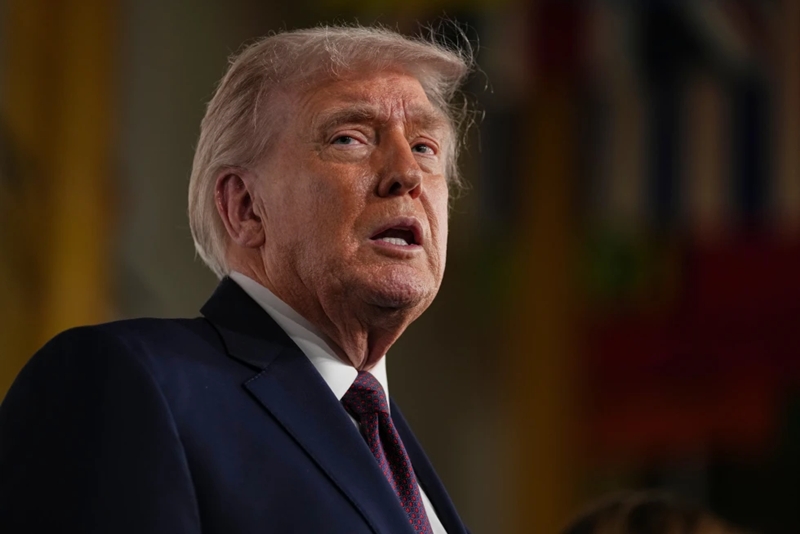
DUBAI, United Arab Emirates (AP): President Donald Trump expressed frustration Tuesday with allies who have been unwilling to do more to support the U.S. war effort, telling them to “go get your own oil” as the conflict with Iran and its closure of the Strait of Hormuz sent average U.S. gas prices past $4 a gallon.
The president’s social media post came after U.S. strikes hit a city that is home to one of Iran’s main nuclear sites, sending a massive fireball into the sky, and Tehran attacked a fully loaded Kuwaiti oil tanker in the Persian Gulf.
The attacks showed the intensity of the war more than a month after the U.S. and Israel launched it. The conflict has left more than 3,000 dead and caused major disruptions to the world’s supply of oil and natural gas, roiling global markets.
Trump, who has vacillated between insisting there is progress in diplomatic talks with Iran and threatening to widen the war, had earlier shared footage of the attack on Isfahan. The central city is home to one of three nuclear enrichment sites attacked by the U.S. in June, and analysts believe much of Iran’s highly enriched uranium is likely stored there.
Table of Contents
The war is roiling oil market
Iran’s stranglehold on the Strait of Hormuz, the waterway leading out of Persian Gulf through which a fifth of the world’s oil is transported during peacetime, has driven up global oil prices, as have Tehran’s attacks on regional energy infrastructure. That has shaken stock markets around the world and pushed up the cost of many basic goods.
Spot prices of Brent crude, the international standard, hovered around $107 a barrel Tuesday, up more than 45% since the war started Feb. 28.
Trump directed blame at U.S. allies like the United Kingdom and France that have refused to enter a war with no clear endgame that they were not consulted on.
“You’ll have to start learning how to fight for yourself, the U.S.A. won’t be there to help you anymore, just like you weren’t there for us. Iran has been, essentially, decimated. The hard part is done. Go get your own oil!” Trump wrote.
He singled out France for not letting planes taking military supplies to Israel fly over French territory, saying the country has been “VERY UNHELPFUL,” and that “The U.S.A. will REMEMBER!!!”
Allies have refused to get involved
The French military has previously said France allowed the U.S. Air Force to use the Istres base in southern France, because it had guarantees that only planes not involved in carrying out strikes would land there.
Spain, which has emerged as Europe’s loudest critic of the war, said Monday that it had closed its airspace for U.S. planes involved in the conflict.
Italy has refused permission for U.S. military assets to use the Sigonella air base in Sicily for an operation linked to the offensive in the Middle East, an official with knowledge of the matter said, confirming a local press report.
The denial was issued a few days ago and concerned American aircraft, including bombers, which were supposed to land at the base before continuing toward the Middle East, said the official, who spoke on condition of anonymity because they were not authorized to speak publicly.
The Italian government later insisted that its relationship with the U.S. is “solid and based on full and loyal cooperation.”
Israel and the US launch a new wave of strikes on Iran
Israel and the U.S. launched a wave of strikes on Iran, hitting Tehran in the early morning. Israel also said it had launched a new wave of strikes targeting what it described as Hezbollah infrastructure in Beirut.
The video shared by Trump appeared to show a massive attack on Isfahan, and NASA fire-tracking satellites suggest explosions happened in a mountainous region on the city’s southern edge. Iran has not confirmed the attack.
A satellite image taken just before the June war suggests Tehran transferred a truckload of highly enriched uranium to a nuclear facility about 20 kilometers (12 miles) from Tuesday’s strikes.
Analysts believe the truck — which the image showed going into a tunnel loaded with 18 blue containers — likely carried most or all of Iran’s stockpile of uranium enriched up to 60% purity. That’s a short, technical step from weapons-grade levels.
Trump warned this week that if a ceasefire is not reached “shortly,” and if the strait is not reopened, the U.S. would broaden its offensive, including by attacking the Kharg Island oil export hub and possibly desalination plants.
Speaking at the Pentagon, Defense Secretary Pete Hegseth would not say if U.S. ground forces would enter the war.
“We don’t want to have to do more militarily than we have to,” he said. “But I didn’t mean it flippantly when I said, in the meantime, we’ll negotiate with bombs.”
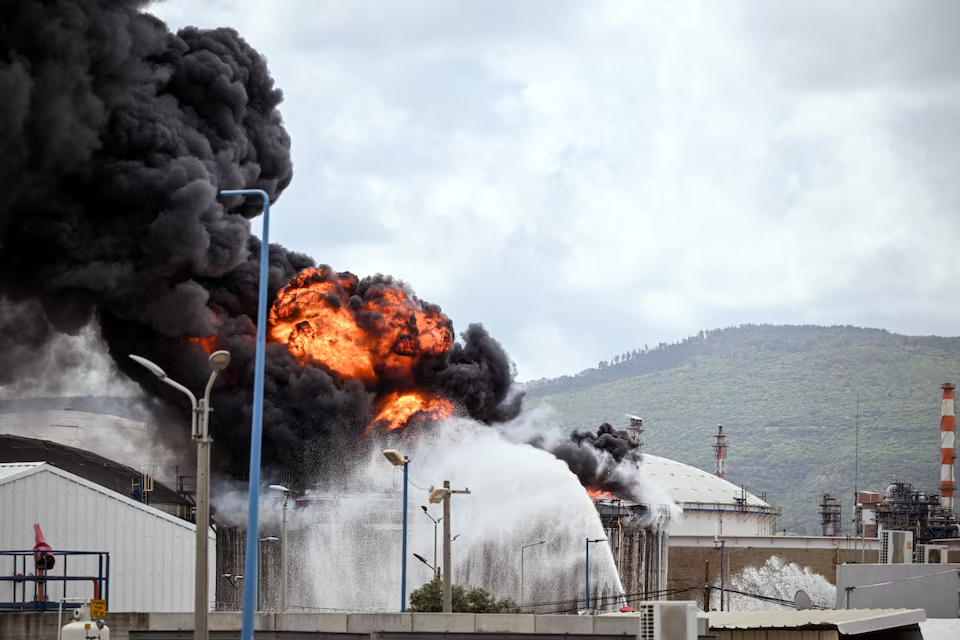
Iran hits oil tanker in waters off Dubai
An Iranian drone hit a Kuwaiti oil tanker off the United Arab Emirates city of Dubai, sparking a blaze that was later put out, the Dubai Media Office said. Authorities said no oil spill resulted.
Four people were also wounded when debris from an intercepted drone fell into a residential area, and loud explosions could be heard later from another attack on Dubai.
In Iran, authorities say more than 1,900 people have been killed, while 19 have been reported dead in Israel.
Two dozen people have died in Gulf states and the occupied West Bank. In Lebanon, officials said more than 1,200 people have been killed, and more than 1 million displaced.
Ten Israeli soldiers have died in Lebanon, including the four announced Tuesday, while 13 U.S. service members have been killed.
FAQs
How is the conflict with Iran affecting global oil prices and U.S. gas markets?
The U.S.-Iran conflict has driven Brent crude prices to approximately $107 per barrel, a 45% increase since the war’s onset on February 28. This surge is primarily caused by Iran’s blockade of the Strait of Hormuz and targeted strikes on energy infrastructure, which have pushed U.S. average gas prices past the $4-per-gallon threshold.
What caused the recent escalation between the United States and Iran in Isfahan?
Tensions escalated following U.S. airstrikes on Isfahan, a central Iranian city housing critical nuclear enrichment sites and stockpiles of highly enriched uranium. In retaliation, Tehran deployed a drone to attack a fully loaded Kuwaiti oil tanker off the coast of Dubai, intensifying the maritime conflict in the Persian Gulf.
Why are European allies refusing to support the U.S. military offensive?
Major European allies, including France, Spain, and Italy, have restricted U.S. military access to their airspace and bases to avoid involvement in a conflict lacking a clear diplomatic endgame. These nations have prioritized regional stability and domestic policy over the U.S.-Israel coalition, leading to a visible fracture in traditional Western security alliances.
What is the current human toll of the war in the Middle East?
The total death toll of the conflict has surpassed 3,000 individuals across Iran, Israel, Lebanon, and the Gulf states as of March 31, 2026. Lebanon has faced the most severe humanitarian impact, with over 1,200 fatalities reported and more than 1 million residents displaced by the ongoing strikes.
How has the U.S. administration responded to the lack of international support?
President Trump has adopted a “transactional” foreign policy stance, explicitly telling allies to “go get your own oil” if they refuse to contribute to the war effort. This shift signals a potential withdrawal of U.S. security guarantees for nations that have obstructed military logistics, such as France and Spain.